



O’Melveny & Myers: Expanding the Art of Possible With :Harvey:
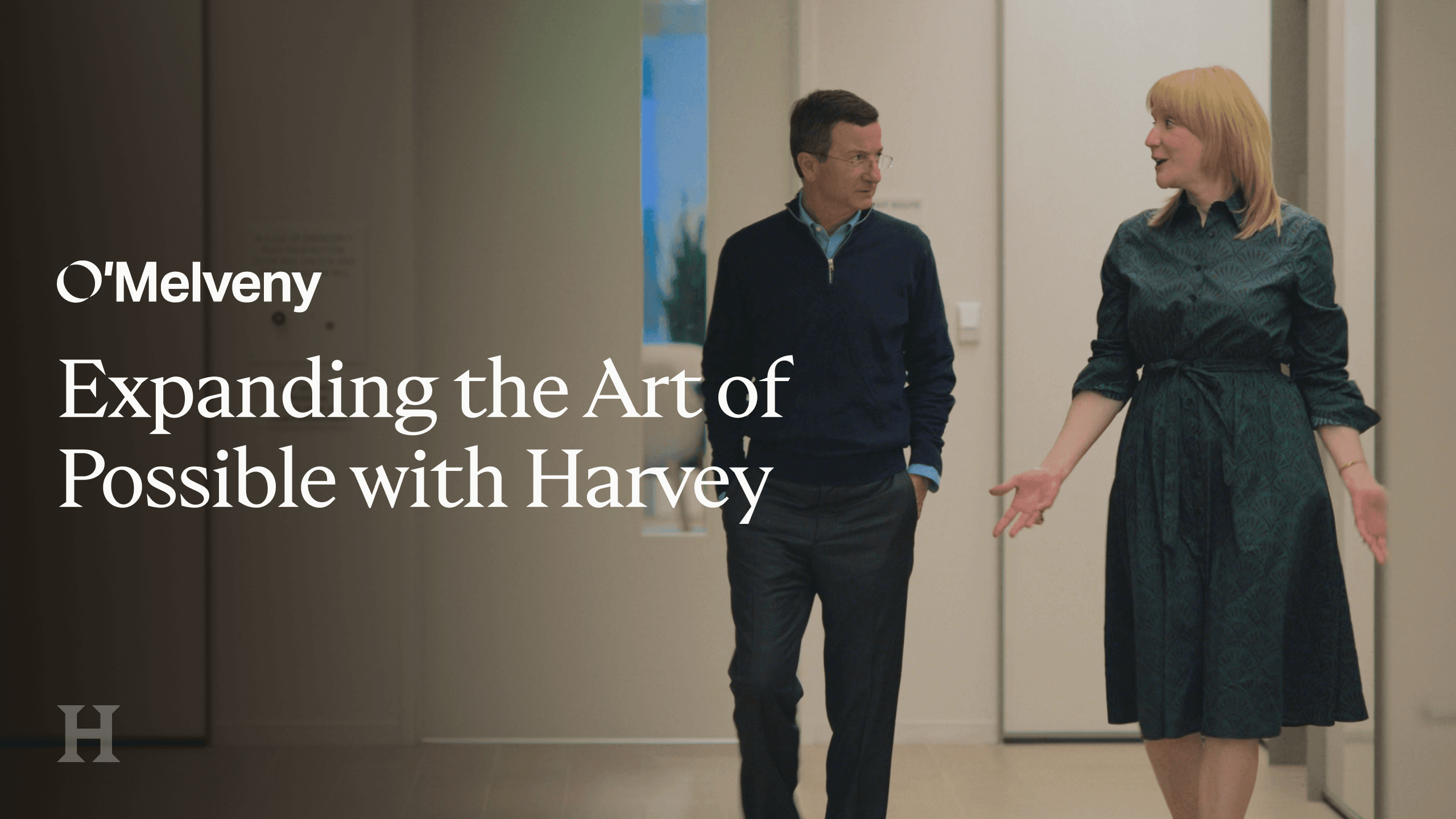
“The practice is more elegant. We are having to enhance our own game to become that trusted advisor. :Harvey:’s enabling us to do that.”
Michael Hamilton
Partner and Chair of Project Development and Real Estate, O’Melveny & Myers
Key Highlights
- Hidden entitlements and obligations surfaced across a newly acquired property portfolio
- Litigation arguments pressure-tested against likely opposing counsel responses
- Collaborative work alongside clients via Shared Spaces
- Firmwide AI-positive culture reinforced through "AI minutes" at every meeting
About O’Melveny & Myers
Founded in 1885 as the first law firm in Los Angeles, O’Melveny & Myers has spent 141 years providing premier counsel and contributing to some of the most notable cases in American legal history. From the legal work that first brought water to its home city to a significant role in Brown v. Board of Education, the firm continues to be relied upon for creative legal arguments at the highest standard of the profession.
Opportunity
For most of the profession’s history, the answer to a hard question was brute force — more associates, more hours, more charts. O’Melveny asked whether that was still the only answer.
“We’re interested in discovering and exploring opportunities to use generative AI to better serve our clients and to upskill our workforce with the best tools,” says Ali Shahidi, O’Melveny’s Managing Director for Information.
The firm built an AI-positive culture around that idea. Attorneys use Harvey on a wide range of live matters, develop their own use cases, and share them during “AI minutes” segments at every meeting.
O’Melveny wasn’t merely optimizing for speed. “We are not chasing efficiency for efficiency’s sake,” Shahidi says. “We are focused on amplifying the quality of the work that we do.”

Solution
From Brute Force to Thought Partner
Brittany Rogers, Litigation Partner and Managing Partner of the Los Angeles office, describes the old reflex plainly. “When something came up, you’d think to yourself, ‘Is brute force the only way we can do this?’” says Rogers. “Now it isn’t. Now my first question is, ‘Can we use Harvey?’”
She drafts a motion to dismiss, puts it into Harvey, and asks what opposing counsel is likely to argue in response. “Harvey helps me be more thoughtful, more careful, more aware,” Rogers says. “It can help me identify my own blind spots.”
The questions she can afford to ask have changed, too. “So many times things come up in litigation where you want to know something, but it’s going to require you to take 20 hours to create a chart. Harvey lets me focus on strategy,” says Rogers.
Finding What No One Knew to Look For

O’Melveny’s Michael Hamilton, Partner and Chair of Project Development and Real Estate, received a call from a public company after it had acquired a portfolio of properties it didn’t yet fully understand. The assignment: ferret out the surprises in the documentation.
Hamilton’s team used Harvey to scour the entire file and build a compliance audit checklist. The client now understands its contractual obligations, as well as entitlements it never knew it could exercise. “It’s mind-blowing what it can do,” Hamilton says. The client left the engagement far more knowledgeable about its own assets, in a very short timeframe.
Built for the Way Lawyers Work
Adoption didn’t require a mandate. “The ability for our attorneys to pick it up with minimal guidance and interface with it was key,” says Shahidi. “We could see how easily Harvey could be adopted because of the design.”
In negotiations, Hamilton now grounds positions in evidence. He can now quickly establish how frequently a provision appears in a lender’s last 100 loans before arguing that the term is market standard.
O’Melveny also deploys Harvey Shared Spaces with clients, so both sides work the same problem in the same environment. “It’s how we do it,” Hamilton says. “That culture of innovation and entrepreneurial thinking is special here. Our adoption rate was very high.”
Impact
“We now have an opportunity to focus on better risk advising, strategy, and solutions,” Hamilton says. Attorneys across the firm report that Harvey enables them to reallocate time to deeply reflect on the needs of their clients — and exercise better judgment as a result. Lease abstract reviews that previously required extensive human effort to complete have been compressed significantly with the aid of Harvey.
“AI will accelerate and amplify what our attorneys do,” says Shahidi. “The whole industry is ripe for change, particularly in the ways firms can responsibly collaborate with clients. O’Melveny is focused exactly on that.”
Rogers sees the same horizon. “What a cool time to be a lawyer,” she says. “The demand for high-level legal services is always going to be there. Our clients don’t come to us because things are easy. We want to give them our best.”