


Pushing the US Open-Weight Frontier
Applying the Harvey Tenet training recipe to US open-weight models.
Since we launched Harvey Tenet in August, there has been a surge of progress in open-weight models, including from US labs at Meta, NVIDIA, Reflection, and Thinking Machines. In this work, we set out to understand how the latest models perform on agentic knowledge work and how much post-training improves that performance.
With Baseten, we post-trained four recently released US open-weight models – Muse Spark Open, Nemotron 3.5 Super VL, Beam 1.0, and Inkling 2 Small – using a recipe adapted from our Harvey Tenet work. For comparison, we also post-trained GLM-5.3, a non-US open-weight model of similar size. We evaluated each model on agent benchmarks spanning law, consulting, banking, business automation, and software engineering.
Our results show that post-training leads to substantial gains in both agentic legal reasoning and task completion across the models we studied. Specifically, we find:
- Muse Spark Open achieves 30.3% all-pass on LAB after post-training, the highest all-pass rate reported on the benchmark thus far and the first model to surpass 30% overall.
- Nemotron 3.5 Super VL, Beam 1.0, and Inkling 2 Small each score above 20% all-pass on LAB after post-training, surpassing the mark we reached previously with Kimi K3, a model more than three times their size.
- Performance does not regress in other capability areas. The post-trained models maintain their scores on non-legal benchmarks and even show some improvement on SWE-bench Pro beyond what is gained purely through increased reasoning. We plan to study this behavior more in future work.
The sections below outline our findings in more detail, including benchmark performance, lawyer preference evaluations, and efficiency results across each of the models we trained.
Performance
We post-trained each model with an extension of our Harvey Tenet recipe to improve its ability to perform long-horizon, agentic legal tasks. Table 1 details each model’s performance after post-training.
First, we find that post-training consistently leads to strong in-distribution gains in agentic legal reasoning. Muse Spark Open successfully completes 58% more tasks on Legal Agent Bench and is the first model to break 30% all-pass on LAB. Nemotron 3.5 Super VL, Beam 1.0 and Inkling 2 Small also each exceed 20% all-pass. These results suggest that US open-weight models are becoming competitive options for agentic legal work alongside the non-US models we have previously studied.
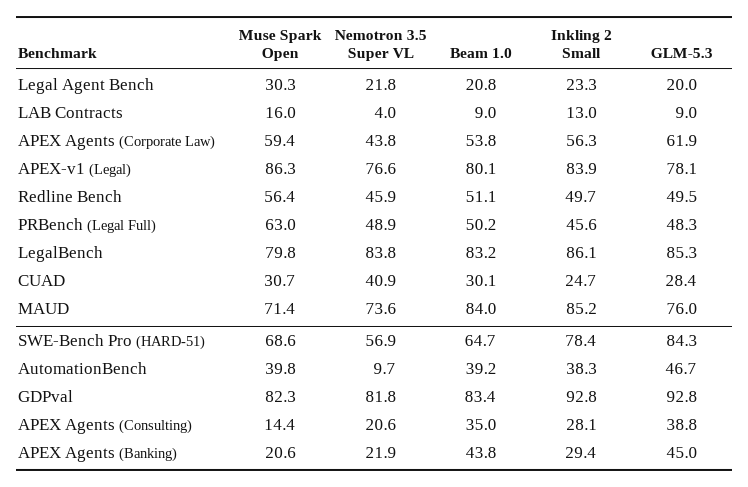
Next, we find these improvements generalize to other legal agent benchmarks, including LAB Contracts, Mercor’s APEX Agents (Corporate Law), and Crosby’s Redline Bench, where each post-trained model scores higher than its base. Inkling 2 Small completes more than three times as many LAB Contracts tasks, increasing all-pass from 4.0% to 13.0%. Beam 1.0’s Redline Bench score increases from 40.6% to 51.1%. None of these benchmark tasks were used in our post-training, showing that the improvements carry across legal tasks and agent harnesses.
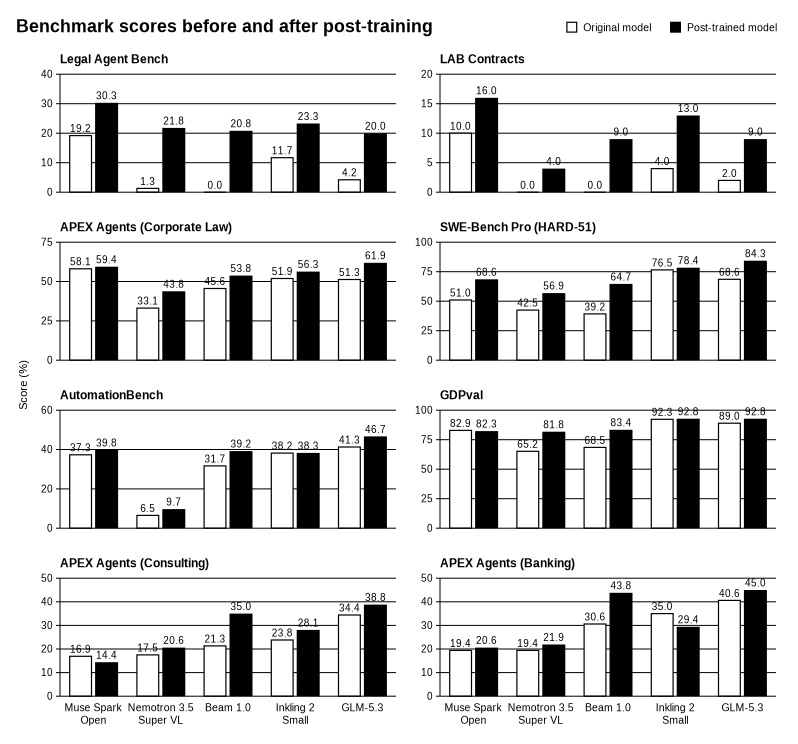
We also evaluated the models on AutomationBench, GDPval, APEX Agents (Consulting and Banking), and SWE-bench Pro (HARD-51) to check for regressions outside of the legal domain. The models generally maintain performance on these benchmarks and, surprisingly, improve on SWE-Bench Pro despite no software engineering tasks being included in training. The observed performance gains coincide with increased token use and may partly reflect longer reasoning, a relationship we plan to study further. In the Efficiency section below, we examine this relationship for Muse Spark Open on LAB and SWE-Bench Pro.
Lawyer preference
We ran a pairwise generative reward model (GRM) tournament, comparing work products from both original and post-trained models on held-out LAB tasks. For each task, the grader compared the two deliverables in both presentation orders, with model identities withheld. It assessed model outputs across preference axes such as accuracy, style, tone, reasoning, and alignment. We converted the resulting pairwise preferences into Elo ratings to summarize each model’s relative standing in the tournament (see Figure 2).
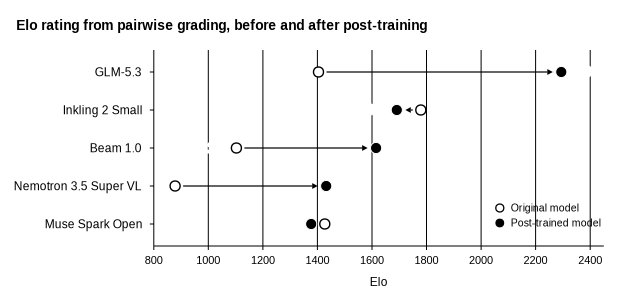
We find substantial gains in GRM preference for Nemotron 3.5 Super VL, Beam 1.0 and GLM-5.3. In direct comparisons, the grader prefers each post-trained model over its respective base in 98% of judgments. For Muse Spark Open and Inkling 2 Small, neither head-to-head win rate differs significantly from 50%, despite both models improving on LAB rubrics.
The individual preference axes help explain these results. All five post-trained models improve on coverage, and Nemotron, Beam and GLM-5.3 also improve on accuracy and reasoning. For Muse Spark Open, improvements in accuracy, grounding and reasoning accompany declines in alignment, style and tone. Inkling 2 Small improves on coverage and grounding while receiving lower ratings for accuracy and tone.
These results suggest that optimizing rubrics alone does not consistently improve preference for the final work product. The three models that improve in preference start below 5% all-pass on LAB, while Muse and Inkling start above 10% and improve task completion without a corresponding preference gain. One possible explanation is that rubric rewards improve work-product quality by correcting failures in task execution, but offer less guidance on improving an already capable model’s writing. We plan to test whether incorporating GRM judgments alongside rubrics in the training reward improves work-product preference while preserving the gains in task completion.
Efficiency
As shown in Figure 2, post-training improved performance on LAB, generally maintained performance on non-legal benchmarks, and even improved performance on SWE-bench Pro. Because our reward does not penalize reasoning length, some gains may be attributable to increased reasoning effort. To assess whether post-training also improves performance-per-token, we compared post-trained Muse Spark Open, our highest-scoring model on LAB, with the original model across reasoning settings.
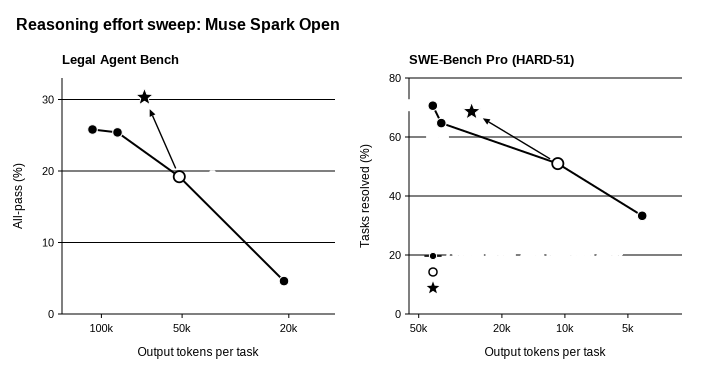
On LAB, post-trained Muse Spark Open outperformed the original model at every tested reasoning setting. It reached 30.3% all-pass rate, compared with 25.8% for the original model at maximum effort, while generating 36% fewer output tokens per task. These results suggest that post-training improves legal-task performance beyond the gains observed from increasing reasoning effort alone.
On SWE-bench Pro (HARD-51), we observed a similar though less-pronounced pattern, with the post-trained model approaching the original’s maximum effort score while using fewer tokens. We plan to study how post-training affects the relationship between reasoning length and task performance, and explicitly optimize for more efficient reasoning while preserving these performance gains.
Training
We post-trained each model's released checkpoint via asynchronous reinforcement learning (RL) in LAB-style agent environments. During training, the agent worked through long-horizon legal tasks and was graded on the work product it delivered via expert rubrics.
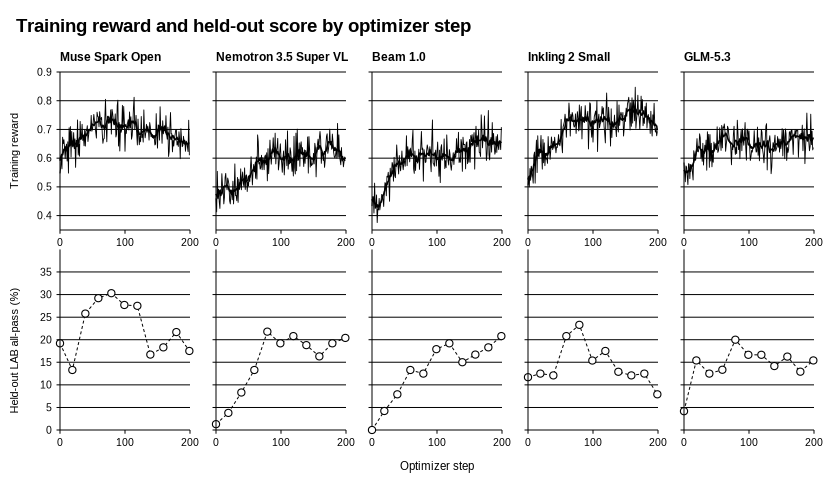
Training reward and hold-out performance improved together early in training. Among the checkpoints evaluated, we selected the checkpoint after 80 optimizer steps for four models and after 200 steps for Beam 1.0. We evaluated checkpoints every 20 steps and report the highest measured hold-out all-pass rate for each model.
Environments
Each task placed an agent in a closed-universe client matter with a short instruction requesting work. The client matter environment included both key and peripheral documents, requiring the agent to identify relevant information across files. It worked in a sandboxed workspace with tools to search the matter, read documents, and draft work product. The episode ended when the agent signaled completion or reached an execution limit. Deliverables were graded against an expert rubric of binary pass/fail criteria.
Reward
An LLM judge marked each rubric criterion pass or fail. Our reward was a weighted sum of the fraction of criteria passed, the fraction of legal issue groups passed in full, and a bonus for passing every criterion. The reward did not include an explicit length penalty.
Optimization
We trained a rank-64 LoRA adapter for each model with CISPO, using the advantage and loss normalization of Dr. GRPO. For each task, we sampled a group of rollouts and computed each rollout’s advantage as its reward minus the group mean. Per-token importance weights were clipped to account for asynchronous sampling.
Infrastructure
We trained Muse Spark Open, Nemotron 3.5 Super VL, Beam 1.0 and GLM-5.3 with Baseten Loops. We trained Inkling 2 Small with Tinker, which supported fine-tuning the model before its weights were released. For all five models, we performed rollouts using Baseten Sandboxes.
Controls
We use the same training environments, reward, judge and optimizer settings across models; and generate rollouts in the default LAB harness. We selected hyperparameters, including learning rate and rollout group size, through a sweep on Nemotron 3.5 Super VL using standard ranges from prior work (CISPO, Dr. GRPO). We then applied the selected values to the other four models. The Appendix outlines the training configurations in more detail.
Conclusion
Our results show that a post-training recipe developed for agentic legal work can be adapted across model families to improve legal task completion. This enables us to build on the advances of open weight models as their capabilities improve while continuing to refine our own training methods for legal work.
Moving forward, we plan to use these findings and other recent results to guide how we benchmark and post-train future models. This includes calibrating GRM judgments with human lawyer annotations, leveraging GRM judgments alongside rubrics as a training objective, and experimenting with reasoning length penalties and adaptive thinking.
We are also developing new benchmarks with more realistic legal work environments and headroom for stronger models. We are partnering with legal experts to define and review tasks and rubrics, and compare model outputs to help us calibrate task difficulty and refine the grading criteria.
This experimental study represents a continued effort to post-train agentic legal models on top of the strongest open-weight models. Our research team does not train on customer data and neither these model checkpoints nor our earlier Harvey Tenet models are used to process customer data. We are working closely with the frontier ecosystem, including model developers and infrastructure partners, to meet our security requirements for future customer use.
Appendix
Models
We reported results for five recent open weight models: Muse Spark Open, Nemotron 3.5 Super VL, Beam 1.0, and Inkling 2 Small, and GLM-5.3. All five are sparse mixture-of-experts (MoE) architectures, but differ in parameter count and sequence processing. We post-trained each model at medium reasoning effort, except GLM-5.3, which we trained at low effort (GLM-5.3 has no default medium effort setting).
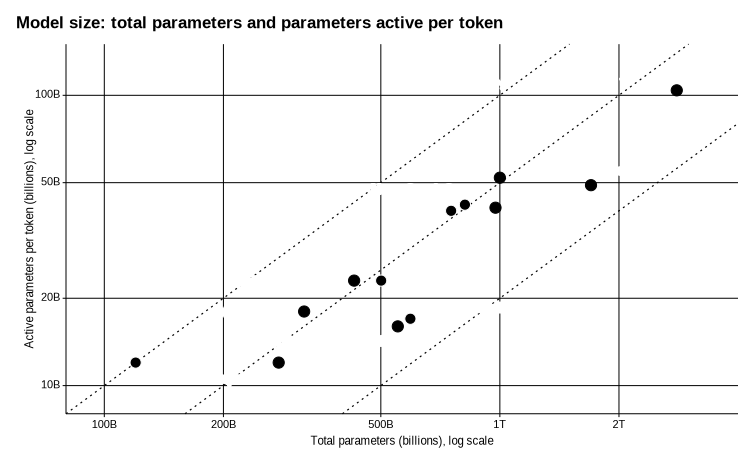
Muse Spark Open (Meta): Muse Spark Open is a sparse MoE Transformer with 816B total parameters and 42B active per token. It uses perception encoders for multimodal inputs.
Nemotron 3.5 Super VL (NVIDIA): Nemotron 3.5 Super VL is the smallest model in the study, with 120B total parameters and 12B active per token. It combines Transformer attention with Mamba-2 state-space layers, which maintain a fixed-size state rather than a key-value cache for every preceding token.
Beam 1.0 (Reflection): Beam 1.0 is a sparse MoE model with 501B total parameters and 23B active per token. It combines gated grouped-query attention with sliding-window attention.
Inkling 2 Small (Thinking Machines Lab): Inkling 2 Small has 594B total parameters and 17B active per token. Its 48-layer architecture uses local and global attention, routing each token to eight of 384 experts.
GLM-5.3 (Z.ai): GLM-5.3 is a sparse MoE model with 744B total parameters and 40B active per token. It uses DeepSeek Sparse Attention.
Training details
Environments
The training set contains 1,250 tasks spanning LAB’s 24 practice areas. It excludes LAB’s separate contracts, firm-knowledge, and diligence task sets. A rollout is one episode on a training task, run in the default LAB harness with network access disabled. An episode ends when the agent signals completion or reaches a turn, context or time limit. We allowed up to 200 turns and one hour of execution time.
Reward
Each rollout is graded by an LLM judge against the task rubric, marking each criterion pass or fail. The rollout reward is:
Here, is the fraction of rubric criteria passed, is the fraction of issue groups passed, and is the all-pass score: 1 if it passes every criterion and 0 otherwise. An issue group contains criteria that test the same underlying legal issue and passes only when all of them pass. We set , and . For tasks without issue groups, the weight on is redistributed over the other two terms in proportion.
The indicator is 1 if a rollout reaches its turn or context limit and 0 otherwise. These rollouts receive zero reward. Otherwise, rollouts that reach the time limit or reply cap are graded on the deliverables written so far. The reward has no explicit length penalty, and near-tied groups are not rejudged.
Optimization
We train a LoRA adapter for each model with CISPO, using the advantage and loss normalization of Dr. GRPO. For each task, a group of rollouts is sampled and each is scored with the reward function. The advantage of rollout is its reward minus the mean reward of its group:
where is the reward of rollout and is the number of graded rollouts in the group. The advantage is not divided by the group's standard deviation. Rollouts that fail for infrastructure or grading reasons are excluded and not resampled. A group is excluded from the update if it has fewer than 6 graded rollouts, or if all of its rollouts receive the same reward and every advantage is therefore zero.
Training is asynchronous, so a rollout may have been generated by an earlier policy version. The reference configuration clips the token-level importance ratio to the following range:
where is the -th token the model generated in rollout , is everything before it in the rollout, is the policy being trained and is the version that generated that token. A token whose ratio falls outside the range remains in the update, with its weight set to the nearer bound.
We maximize the CISPO objective using rollout advantages and clipped token importance ratios :
Here, indexes the task groups in an optimizer step, indexes the graded rollouts in group , and indexes the tokens generated in that rollout. The stop-gradient operator treats the clipped ratio as constant during differentiation. We use as a fixed loss-normalization constant, not a rollout-length limit. The denominator remains fixed rather than varying with the observed number of generated tokens. Only model-generated tokens contribute to the loss; prompt and tool-result tokens are excluded.
Hyperparameters
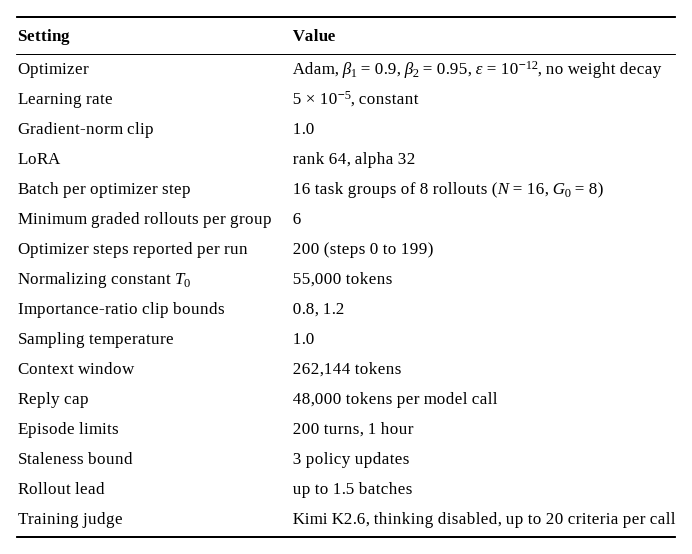
The training configuration in Table A1 is common to all models. Reasoning settings and the numerical format of the weights differ by model. The learning rate and the group size were selected with a sweep over the range and group sizes of 8 and 16, respectively.
Training dynamics
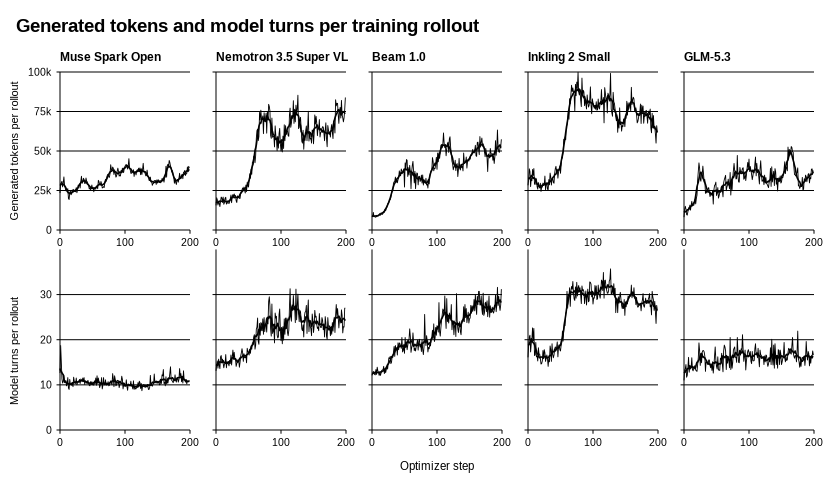
Our objective rewards satisfying the task rubrics and does not include an explicit length penalty. During training, Nemotron, Beam, Inkling and GLM-5.3 increase both output tokens and agent turns, while Muse generates more output tokens without a comparable increase in turns. We plan to explore reward functions that explicitly penalize inefficient reasoning.
Checkpoint selection
Checkpoints are evaluated on the hold-out set every 20 optimizer steps, and for each model we report the checkpoint with the highest hold-out all-pass rate. For Beam 1.0 this is the final checkpoint delivered after 200 optimizer steps and for the rest of the models this is the checkpoint delivered after 80 optimizer steps.
Infrastructure
We trained Muse Spark Open, Nemotron 3.5 Super VL, Beam 1.0 and GLM-5.3 with Baseten Loops. We train Inkling 2 Small with Tinker, which supported fine-tuning the model before its weights were released. For all five models, rollouts run in Baseten Sandboxes.
Additional results
Here we report scores across the legal knowledge and reasoning benchmarks that are common with our Harvey Tenet study: APEX-v1 (Legal), Redline Bench, PRBench, LegalBench, CUAD, MAUD. As in our original study, improvements on LAB generalize to other agentic legal benchmarks. All five models improve on Redline Bench, including Beam 1.0, whose score rises from 40.6% to 51.1%. These tasks were not used during training.
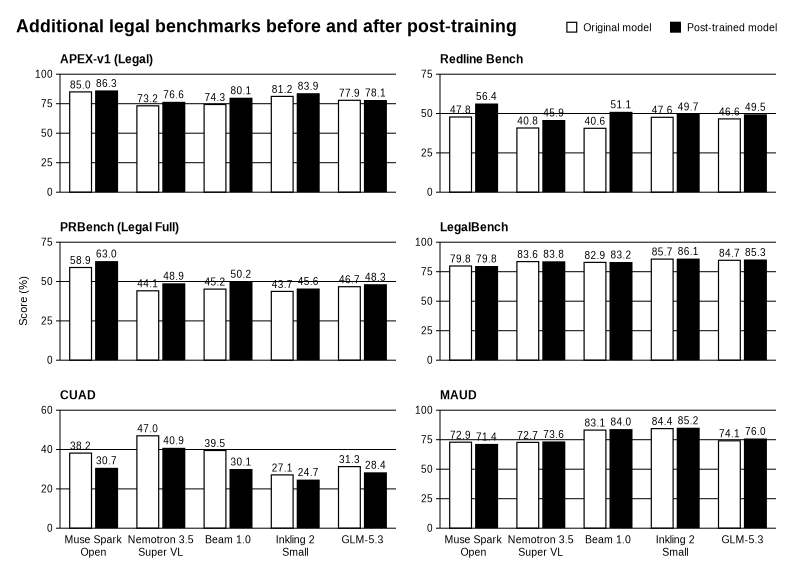
All five models also score higher on the legal reasoning benchmarks APEX-v1 (Legal) and PRBench (Legal Full). Beam’s APEX-v1 score increases from 74.3% to 80.1%, while Muse Spark Open’s PRBench score rises from 58.9% to 63.0%. LegalBench scores change by at most 0.6 percentage points and MAUD scores by less than two points. On CUAD, contract extraction F1 falls by 2.4 to 9.4 points across the five models.
Benchmarks
Benchmark scores for LAB, LAB Contracts, APEX Agents, APEX-v1, Redline Bench, PRBench, LegalBench, CUAD, and MAUD follow the evaluation methodology outlined in our original Harvey Tenet post. Implementation details for new benchmarks are provided below.
SWE-Bench Pro
SWE-Bench Pro evaluates performance on software engineering tasks. We ran its 51-task hard subset (v2.0.0) using Scale’s mini-swe-agent configuration, with limits of 250 turns and 50 minutes per task. Patches are graded using each task’s tests, and we report the fraction of tasks resolved. Episodes that reach either limit are graded on the patch produced so far. We rerun episodes that time out because of deployment overload, using the same limits.
AutomationBench
AutomationBench evaluates business automation across 47 applications. We ran all 600 public tasks (v1.0.6) using Zapier’s default harness and 50-step limit. We report the fraction of tasks that pass every scored check on the simulated business’s final state. Our runs specify both reasoning and sampling settings; Zapier’s published table reports results at maximum reasoning effort but does not specify sampling settings. Its website leaderboard uses a harder, private task set.
GDPVal
GDPVal contains professional tasks spanning 44 occupations and nine business sectors. We ran all 220 tasks in the gold set using Artificial Analysis's Stirrup harness and their GDPval limit of 250 turns. Gemini 3.8 Flash compares each model deliverable with the expert reference using our pairwise prompt, with identities withheld, in both presentation orders. A task counts as a win only if the judge prefers the model’s deliverable in both orders. Ties do not count as wins, and missing submissions count as losses. We report the win rate over the 181 tasks whose expert deliverables the judge can read.
We rerun tasks affected by infrastructure failures, including timeouts caused by deployment overload. Our model-judged win rate differs from Artificial Analysis’s published Elo ratings and OpenAI’s human grading; we therefore restrict comparisons to the runs in this report.
APEX Agents (Consulting, Banking)
Mercor's APEX Agents sets for consulting and banking each contain 80 tasks set in a simulated firm and graded against expert rubrics. We ran v1.1 using Mercor’s agent and system prompt, with limits of 100 steps and three hours. We retained Mercor’s grading configuration, including its judge prompt and judge model, DeepSeek-V4-Flash-0731.
An attempt passes only if it meets every rubric criterion. We report pass@1: the fraction of passing attempts for each task, averaged across tasks. Our two attempts per task, compared with four on Mercor’s leaderboard, estimate the same quantity with lower precision. Models received text only; images returned by tools were replaced with a text note.