


How We Built Agentic Retrieval for Patent Research
In Harvey, an agent navigates fragmented patent sources, decides what information to seek next, and conducts focused research within a bounded budget.
Patent research often requires more than finding a document. A question about a claim may depend on its history: how it changed during examination, how the applicant addressed prior art, and whether later proceedings affected its status.
This is the central challenge of patent research: the answer often depends on following a record over time and deciding what to inspect next. Patent attorneys do this naturally. They start with one document, notice a later event or missing fact, open another record, and continue until the question is supported, or until they can clearly identify the remaining gap.
Consider a question that sounds simple: What does claim 8 cover? A conventional retrieval system can find the patent and return claim 8 as issued. But depending on what the attorney needs to know, the question may involve:
- What did the application originally claim?
- What language appeared in the issued patent?
- How did the applicant distinguish the claim from prior art?
- Is the claim still in force today?
Traditional retrieval-augmented generation (RAG) searches a fixed index, selects relevant passages, and generates an answer. That works when the information is already in one collection and the research path is predictable. In patent research, a result may reveal another record to inspect or another fact to verify.
Harvey’s patent research agent starts with a research question, identifies the information needed to answer it, and selects sources based on what they contain. As it reviews the record, each result guides the next search. The rest of this post explains why a single patent index may fall short, how Harvey’s agent selects sources, and how it uses each result to decide what to search next.
Why a Single Patent Index Falls Short
Patent information is scattered across sources built for different purposes. Published patents contain claims, specifications, abstracts, and drawings. Patent-office systems contain application metadata, prosecution events, Office Actions, assignments, reexaminations, and PTAB proceedings. Patent indexes support broad full-text and semantic discovery. Web sources help cover international patents, procedural materials and jurisdictional gaps. Each source also has its own boundaries and limitations.
Combining these sources into one corpus would be costly to build and maintain. Each new jurisdiction or provider would require more ingestion and normalization, while a larger index alone would not tell the system what information a question needs. The system also needs to recognize when a source is incomplete, choose an alternative, and decide whether the information answers the question or calls for another search.
Our Solution: Agentic Retrieval Across Patent Sources
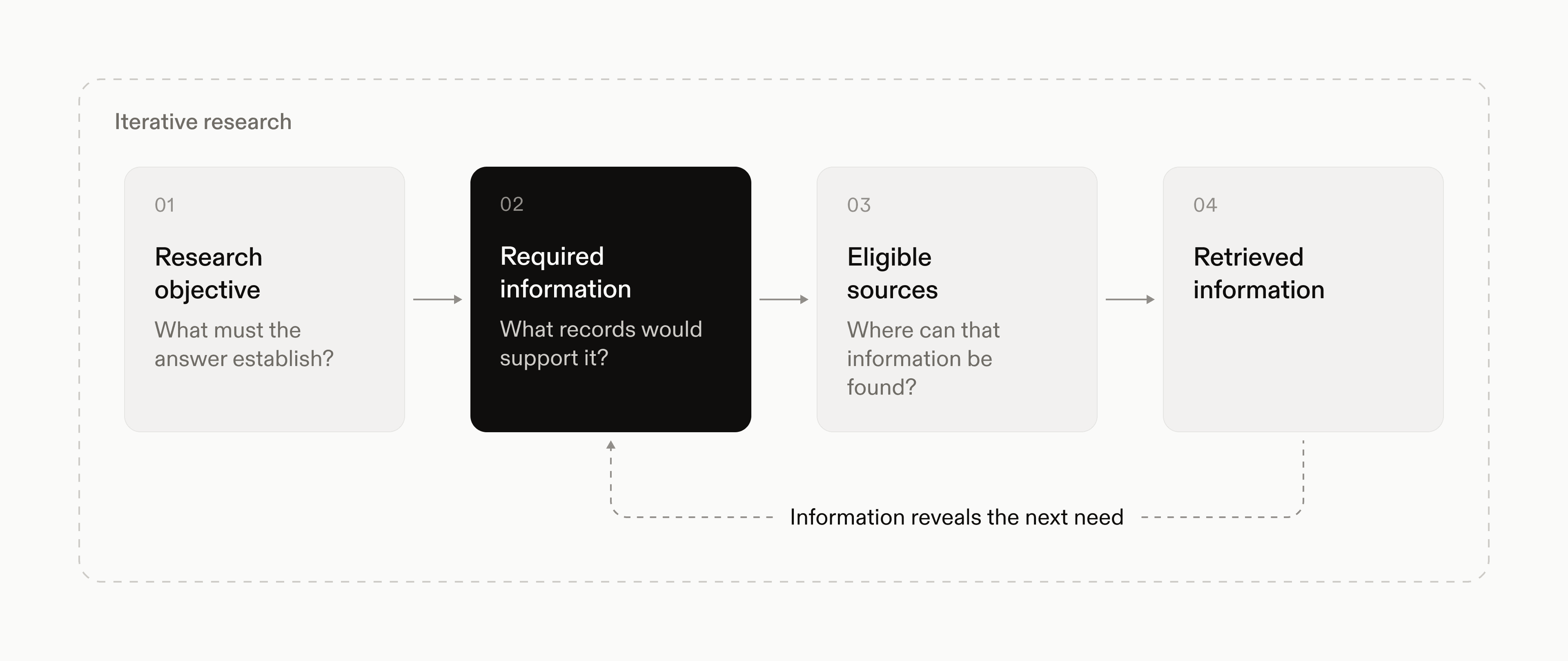
Each research task starts with the question to be answered. Harvey passes it to the patent research agent as a research objective. The agent identifies the information needed and selects from the sources available for that run.
1. Research Objective
The objective describes what the answer must establish without prescribing every retrieval step. Preserving the user’s full question — including patent numbers, claim numbers, timing, and legal context — lets the research agent plan from the desired outcome rather than from a reduced bag of keywords.
2. Required Information
For recurring research patterns, we give the agent concise paths:
Research Task | Typical Path |
|---|---|
Current claim status | Issued claim → reexamination or PTAB history → controlling certificate or decision |
Art applied by an examiner | Office Action record → substantive rejection reasoning → cited reference |
PTAB outcome | Proceeding → decision listing → controlling paper |
Prior-art research | Target claim scope → candidate references → timing and feature comparison |
We do not attempt to enumerate every patent research task. Patent questions are too varied for a fixed decision tree. The built-in paths cover important recurring patterns, while the agent can construct additional paths from the objective and the information it discovers.
These are information requirements, not hard-coded source assignments. The same claim text, decision, or family relationship may be available from more than one source. The agent can choose among the sources available to it at runtime.
3. Eligible Sources
The agent receives a routing table assembled from the sources enabled for the run. Within the table, each data source tells the agent:
- What data it has
- Which information needs it serves best
- Where its material boundaries lie
- Which alternative data source can be a fallback
The routing guidance also sets source priorities and fallbacks. For example, it prioritizes the USPTO for U.S. patent text and identifies Google Patents as an alternative when the USPTO isn’t available in the run.
With this design, the query from earlier (What does claim 8 cover?) runs as follows:
- Objective: Determine the claim’s scope and whether that scope remains operative.
- Required information: Retrieve the issued claim and any later record capable of changing its status.
- Eligible sources: Start with authoritative U.S. patent and post-grant records, using another enabled source when the preferred record is incomplete.
- Research: Inspect the issued text, follow any relevant reexamination or PTAB record, and reconcile the two.
- Stop: Return a cited answer when the objective is supported, or clearly identify the unresolved gap within the run’s bounded research budget.
The research path can change as the agent reviews information. A result may reveal another need, point to an eligible fallback source, or show that the objective is supported. The agent stops when it can return a cited answer, identify what remains unresolved, or if it reaches the run’s research budget.
Looking Ahead: A Shared Information Layer for Patent Workflows
Today, users can attach Patent Research as a knowledge source in Harvey.
The objective → required information → eligible sources model gives each workflow a stable way to request information without coupling it to a provider. Over time, this approach could extend to non-patent literature, international patent-office records, licensed sources, and authorized private records. Each workflow could request the information it needs through the same model, while the agent selects among the sources available to it.
This creates a path for new patent workflows to draw on a shared retrieval layer as Harvey’s patent capabilities develop.