


Improving Agent Accuracy With Harvey Graph
Harvey Graph organizes legal and matter data, maps how it connects, and hands that structure to agents at run time so they deliver high quality, personalized work.
If you have used an AI tool for legal work, you know the ritual. Before you can ask your question, you explain the situation. You upload the documents. You describe the client, the deal, and how your partner likes things done. Then you ask.
And on the next matter, you do it all again.
That routine is changing, in part because models have become much better at legal task execution. We benchmark new models on agentic legal work in Harvey LAB, and the results show how far their capabilities have advanced. When every agent can reason well, what separates them for legal use cases is what they know before they start: context about the matter, the documents, the precedents, your client preferences, and the way your team works. That context is where agent quality succeeds or fails.
Harvey Graph helps provide that context. It organizes firm data and legal knowledge and maps how they connect, so an agent starts a task the way a well-briefed teammate would: already knowing your preferences, the project, and the precedents that matter to the work.
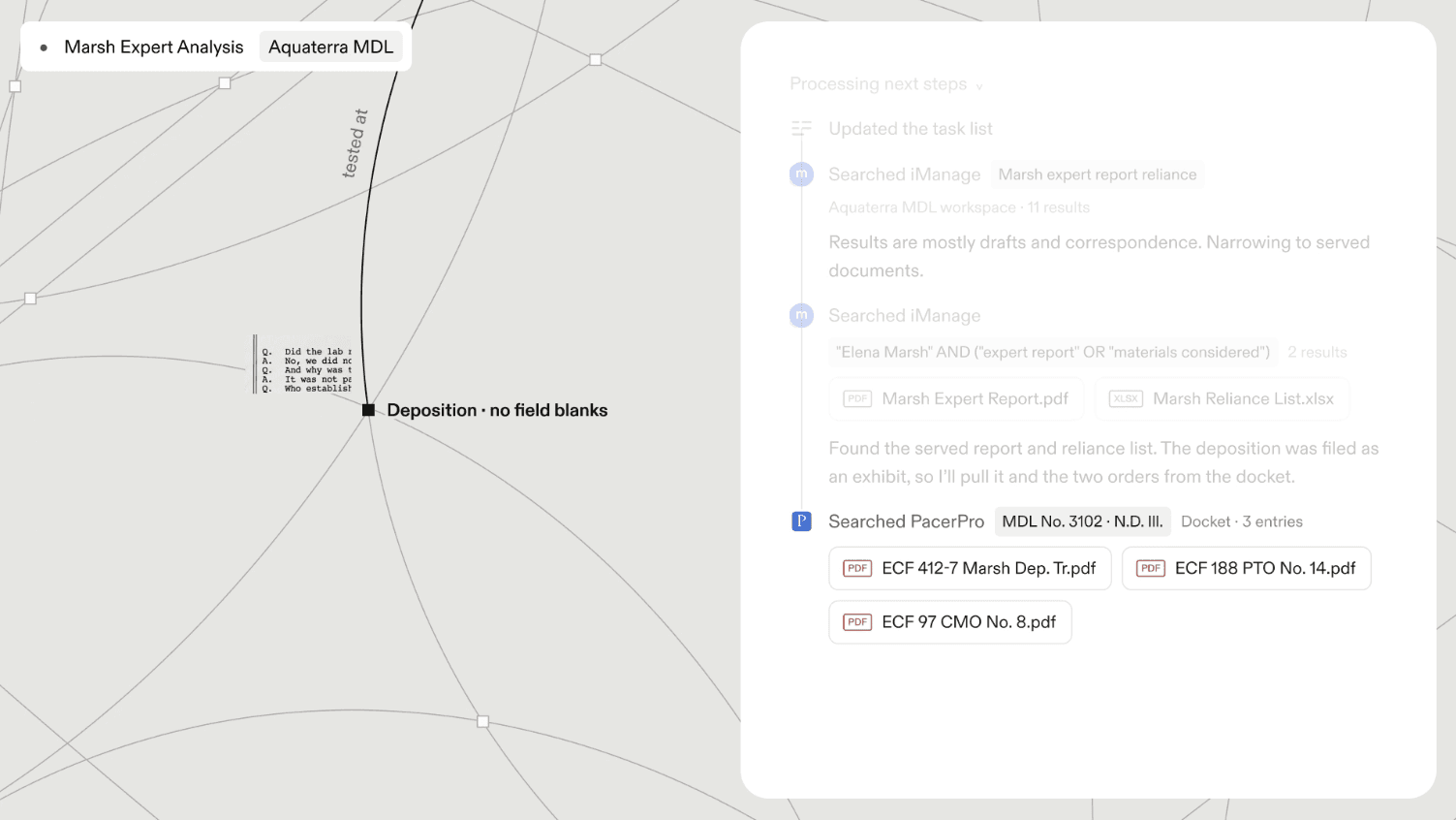
Harvey has spent the past year investing in this context layer of our platform. With the release of Harvey II this month, Spaces provide a closed, private graph of your matter’s data, how it fits together, and how it connects to the people who use it. Additionally, our US Case Law knowledge source uses a graph to map citations and relationships across the body of American case law.
We refer to the combination of all these specialized graphs, and the graphs we have in development, as Harvey Graph. Users will never have to know the graph is there or activate it. But they will notice Harvey asking less of them up front, while consistently delivering accurate work that is verifiable with citations.
How Harvey Graph Improves Agent Answer Quality
Legal work goes beyond being able to read and understand the latest case or draft. It’s highly relational, so agents need to be able to navigate those relationships to deliver accurate outputs. A single credit agreement arrives with drafts, amendments, and side letters, and an agent has to know which version controls before it can answer anything about it. A diligence finding depends on a change-of-control clause, the counterparty it names, and the deal timeline it sits in.
Lawyers hold these connections in their heads, and without a graph, agents try to rebuild and assume the connections from raw data and files on every task. Flat retrieval (chunks ranked by similarity) finds passages, not relationships. An agent working this way re-discovers the same entities and cross-references task after task, spending time and tokens to recover structure that was already in the documents.
The technical solution sounds simple: better-organized context, a graph that maps the relationships between documents, work product, people, matters, and knowledge. The difficulty is in the word “relationships.” A firm’s data doesn’t announce how it connects. Nothing in a document says it’s the fourth draft of an agreement that was later superseded, that the counterparty in it is the same entity under a different name in another matter, or that the case it relies on was overruled last year.
All of those connections have to be inferred, verified against the source, and kept current as the firm’s work changes — across millions of documents and governed by existing permissions and ethical walls.
What’s in Harvey Graph Today
The main Harvey Agent plans and orchestrates work across the platform. Custom agents handle specialized tasks behind the scenes, so users don’t need to select or manage them.
The Harvey Graph works the same way. Specialized graphs map specific kinds of context and data for the agents that need them. They follow your Space’s governance and security settings automatically, with no user management required.
What sits within Harvey Graph today:
- Knowledge graph: a structured map of legal knowledge for US Case Law and the relationships and citations connecting it.
- Context graph: a per-Space map of how matters, data, and documents from your Vaults and integrations connect.
For US Case Law, Harvey built the knowledge graph across the whole corpus. Millions of opinions across every federal district and appellate court and all 50 states. We extracted how they relate: who cites whom, how a case has been treated, where a line of reasoning holds and where it breaks.
And we give that map to the Harvey agent. So when you ask a question, it doesn't run one search. It retrieves authority, follows the citations out, checks how those cases were treated, and checks its own work against what you asked.
The investment in Harvey Graph is far from complete. We are continuously extending the relationships it captures: how matters connect to the people, entities, and documents inside them; how a draft relates to the executed agreement it became; and more.
Over the coming months, Harvey will launch precedent flags and cite checking for US case law, law evolution tracking across authorities, a new legal research surface built for following those connections, and the ability for firms to define their own legal ontology on top of their documents in Harvey.
This graph value compounds with our investments in memory. Harvey learns how you prefer to work — drafting style, citation habits, house rules — so every output comes back closer to final from the first prompt, without re-briefing. Next, memory accrues to your Spaces, so context about a matter compounds over time. Every memory will stay transparent, traceable, and under your control.
Strong Early Eval Results for Harvey Graph
We ran a series of experiments on Legal Agent Bench to evaluate how structured context improves legal agent performance. For each LAB task we evaluated, an agent first reviewed each document in its client matter and built a graph of relevant entities and their relationships (for example: parties, dates, draft vs. executed status, and which versions belong to the same contract.)

To evaluate the impact of the graph, we compared the performance of an agent with and without the context graph, using LAB’s standard grading setup. Overall, the agent with the context graph improved rubric pass rate by up to 30% while reducing task cost by up to ~50%.

In some cases the graph led to massive improvements. For example, in one firm-knowledge task, the agent was asked to find the firm’s most recent secured financing and retrieve the executed credit and security agreements as precedents for a new facility.
An agent working from raw files attempted to search through several files sequentially and looked at many different matters, but ultimately selected the wrong precedent (0% of rubric criteria). With the context graph, the same agent found the relevant matter and its executed agreements immediately (75% of rubric criteria).
We also run evals and qualitative testing on our Harvey Agent performance. After the GA of user memory last month, we surveyed users and found that 93% of respondents say memory makes Harvey more useful and 50% say they now repeat less context.
These are early results, and we will keep publishing more as the experiments move into production. This is a priority investment for our engineering organization because we believe the next gains in legal AI will come from what an agent knows before you ask, not just from a smarter model.
As a result, you will continue to notice that the ritual gets shorter. Harvey asks less, finds the right thing faster, and starts every matter already knowing what exists and what counts.
Learn more at Harvey Forum Chicago and contact us below for a demo of Harvey.


