


Making Harvey the Orchestration Layer for Legal Work
Legal Work Orchestration brings the phases, tasks, and reviews of a matter or project into the same place as the documents and the agents.
Today, we’re launching Legal Work Orchestration, a new way to organize and manage legal matters in Harvey. It connects the phases, tasks, people, and review points within a matter so that agents can execute defined tasks, lawyers can review their work at designated gates, and everyone involved can see what needs to happen next.
Much of legal work follows a repeatable process. An M&A transaction, for example, moves through familiar phases, tasks, and review points. But the process itself often has to be reconstructed for every new matter from a checklist, a previous deal, or the knowledge of the people who have done it before.
AI agents can already complete many individual steps within that process. What they often lack is the structure around the task: where it fits in the matter, which documents and instructions apply, who should review the output, and what happens next. Lawyers still have to provide that context, move the work between people and systems, and track its progress.
Legal Work Orchestration brings that structure into Harvey, allowing lawyers and agents to work through a matter together in one place.
How Legal Orchestration Works
The same structure can support any matter or project a team runs more than once, from an M&A transaction to a quarterly compliance review. Legal Work Orchestration captures that process in a reusable template, carries the relevant context into each task, and coordinates reviews and next steps.
Capture the Process in a Reusable Template
Templates capture how your organization runs a recurring type of work. When an associate opens a new buy-side acquisition, the Space can already contain the relevant phases, tasks, playbooks, agents, collaborators, and review gates. Innovation and knowledge teams can define that structure once, helping teams follow a consistent process across matters without rebuilding it from scratch.

Give Every Task the Context it Needs
Each task includes its scope, inputs, and reviewer. An agent assigned a change-of-control review can therefore analyze the relevant contracts and produce a consent matrix without the lawyer having to assemble a new prompt and briefing for that step.

Tasks can also be assigned to another lawyer or shared with the client while retaining the relevant matter context. The work no longer depends on one person manually carrying information from one step to the next.

Keep Reviews and Next Steps Moving
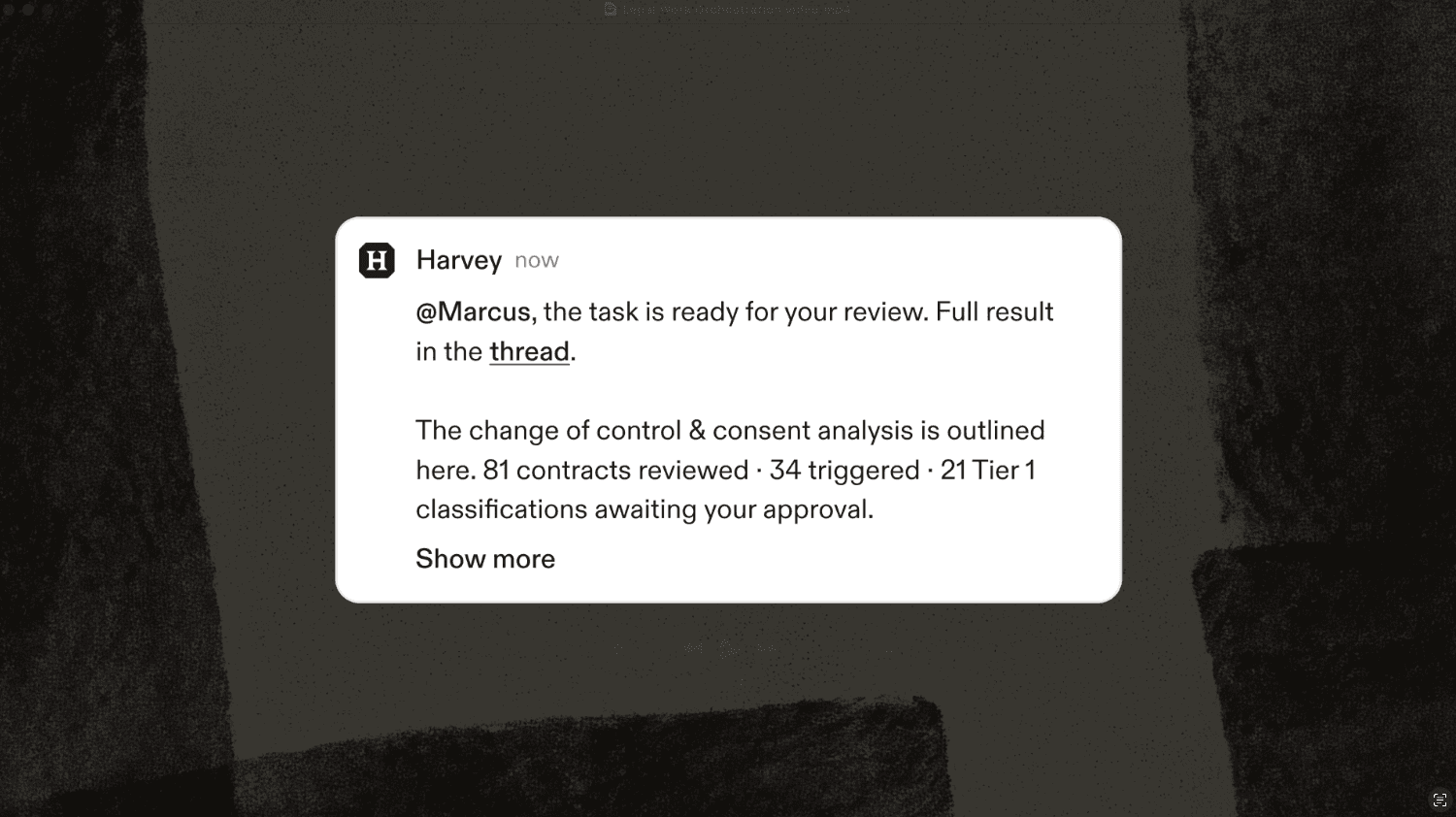
When the agent completes the review, Harvey notifies the designated partner that the consent matrix is ready. Once the partner approves it, the task is completed and the next step can begin. Updates can also be made from email. A lawyer can ask Harvey in a reply to close a task or begin the next one, while the Space maintains a current view of the matter’s progress. Partners can see where the work stands without asking an associate to reconstruct the status from email and separate checklists.

The Future of Legal Work Orchestration
Before the release of Harvey II in August, every step delegated to Harvey required a lawyer to gather the documents, write the instructions, and move the output to wherever it needed to go next. Legal Work Orchestration reduces that overhead by giving each task its inputs, instructions, and reviewer in advance.
Today, lawyers still actively prompt the majority of steps in a legal workflow. We expect that balance to change rapidly. Over the next six months, we expect agents to take on an additional 20% of workflow steps. Within a year, we expect that share to triple.
Lawyers will remain in control through defined review gates, and the work performed by agents will remain transparent and auditable. But as agents take on more of the execution, lawyers will be able to focus more of their attention on directing the matter, reviewing consequential outputs, and exercising judgment.
Legal Work Orchestration, which includes tasks, commenting on tasks, and notifications, is rolling out across Harvey workspaces now. If you’re interested in joining the early access program for templates, reach out to your Harvey team. Request a demo below if you aren't yet a Harvey customer.


