


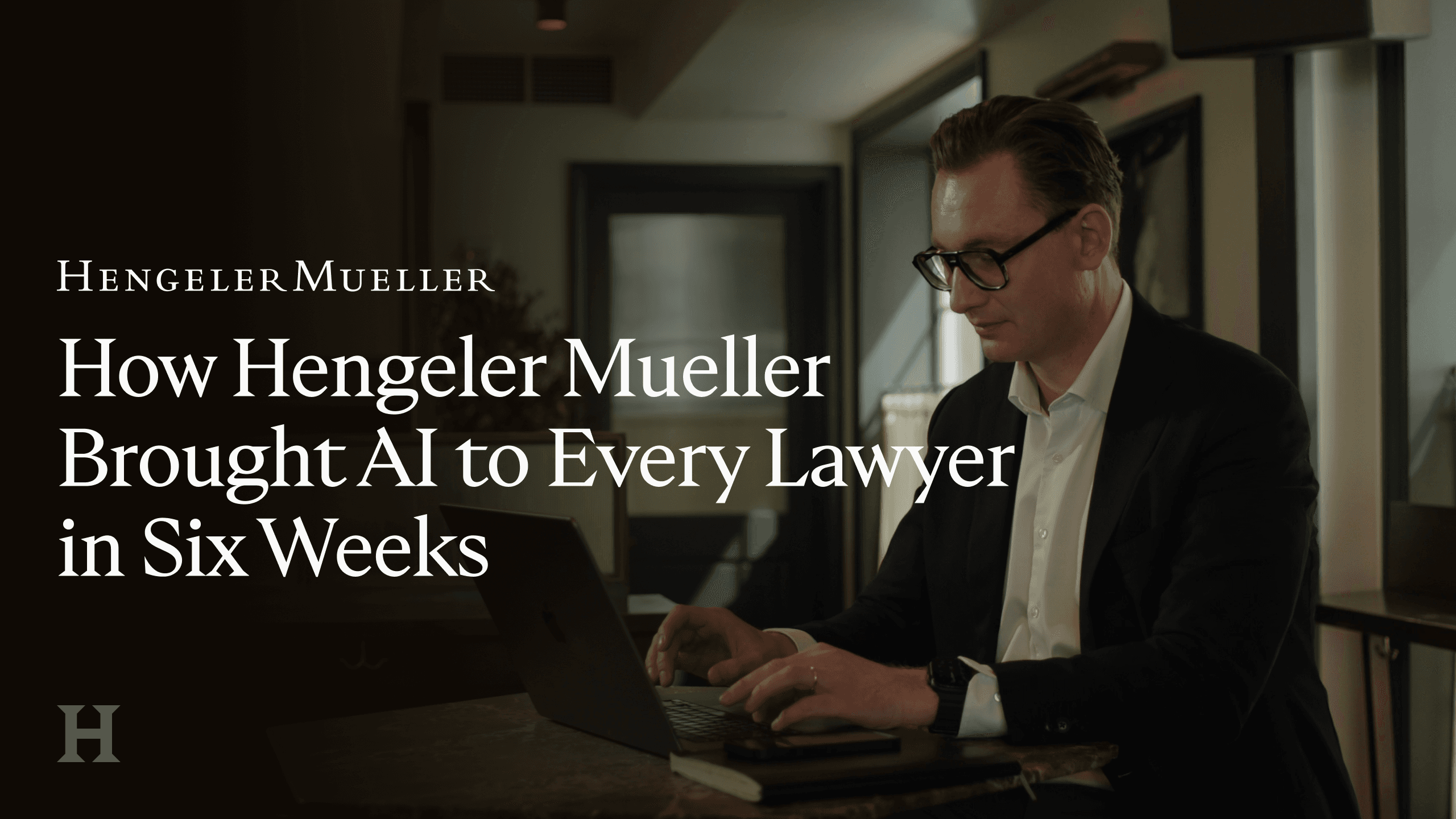
Momentum Over Perfection: How Hengeler Mueller Brought AI to Every Lawyer in Six Weeks
“AI is a prerequisite for every law firm. There’s no room to wait. If the interest is there, you grab the momentum.”
Pierre Zickert
Counsel and Head of Legal Technology, Hengeler Mueller
Key Highlights
- 450+ lawyers across six offices in three countries
- Firmwide rollout of Harvey achieved in just six weeks
- 96–97% firmwide adoption, with roughly 4,000 prompts run per day (and climbing)
- Up to 95% less time spent on due diligence review; up to 30% on summarization
About Hengeler Mueller
Hengeler Mueller is one of Europe’s leading international business law firms, advising major corporations, financial institutions, and private equity investors on their most complex transactions, disputes, and regulatory matters. With more than 450 lawyers across six offices in Berlin, Düsseldorf, Frankfurt, Munich, Brussels, and London, it sits at the top tier of German and European practice in M&A, capital markets, finance, and disputes.
“At Hengeler Mueller, the goal is simple: combine the highest level of legal expertise with constant innovation in how we deliver it,” says Pierre Zickert, Counsel and Head of Legal Technology.
Opportunity
For a firm at the top of the German market, the AI question was rather simple: could it be trusted with the most confidential work in one of the world’s strictest jurisdictions?
“For us, adopting AI was never just about capability. It was about trust,” says Zickert.
Harvey cleared that bar from day one, with EU-only data processing and legal-grade security. But confidence around security was only half the decision. The market was moving, curiosity was peaking, and the firm wanted to move decisively. “When momentum is there, you either act quickly or you lose it,” says Zickert.
Solution
A firmwide rollout, built in six weeks
Hengeler Mueller launched Harvey internally just before Christmas, giving its Legal Tech Center team six weeks to bring the whole firm up to speed.
“Transformation works best when you move with the momentum, not against it,” says Zickert.
The rollout ran in three phases:
- Mandatory online training paired with AI governance and the ticket to a license.
- In-person workshops in every office that pushed lawyers past prompting into building their own workflows and playbooks.
- An AI Championship. In each office, lawyers built Harvey workflows in hackathons and pitched them in five minutes at an evening reception, where colleagues voted live. The prize was a bottle of champagne, opened on the spot.
“The key to adoption is not only training — it is creating energy around the transformation,” Zickert says.
Keeping the fire burning
A launch is not a finish line. “Introducing a tool is easy. Making it truly used is the real challenge,” says Zickert.
The Legal Tech Center, Hengeler Mueller’s team of legally qualified professionals whose job is to coach fee earners, built a rhythm to compound adoption. It consisted of a weekly, under-15-minute “Harvey Espresso” call, a weekly open firmwide call, standing slots in practice-group meetings, and a shared use case library. The team acts as coaches, not gatekeepers.
“Innovation does not happen in a central department. It happens at every desk,” Zickert says.
Where the work changed
In due diligence, Hengeler Mueller deal teams use Harvey Vault to move through large data rooms in a fraction of the time, cutting time spent on document review by up to 95%. “Harvey turns the first pass through complex information from hours of manual work into minutes of structured insight,” says Zickert.
Across the firm, Harvey workflows populate standard documents, summarization runs up to 30% faster, and the “blank page problem” has largely disappeared. The sophistication has surprised even Zickert, who has witnessed trainees, who are just days into their time at the firm, building elaborate due diligence and statutory-analysis workflows in Harvey.
Impact
The numbers read like a benchmark. Harvey adoption sits at 96–97%, with around 4,000 prompts run per day — and rising. More telling than volume: associates are forming their own working groups and trading increasingly sophisticated use cases.
“There’s no indifference any longer. People love the product. The most important thing is they feel something,” Zickert says.
For a leader who once fought for feedback, that engagement is the real proof.
The momentum now points outward, toward client-facing shared spaces and agents that execute multi-step legal work end to end.
“What’s striking is how it keeps innovating. Every two weeks, something new is rolled out,” Zickert says. What excites him most is what it gives lawyers back.
“The lawyer of the future will again have the freedom of thinking. You can actually do what a lawyer was always meant to do.”