


Introducing Harvey’s Fact Graph for Disputes, Litigation, and Investigations
The Harvey fact graph helps disputes, litigation, and investigations teams find and connect facts across millions of documents and build on one evolving record.
We’re introducing Harvey’s fact graph, a new capability for disputes, litigation, and investigations teams to find and connect facts across millions of documents. It links those facts to supporting sources, to one another, and to the people, events, and issues they concern—helping teams uncover relationships across the full record over the lifetime of a matter.
The fact graph is the newest addition to Harvey Graph, the connected map of legal knowledge and matter context that Harvey’s agents draw on to find the right information, cite it, and carry it forward.
From Individual Facts to a Strategic Narrative

In litigation and investigation matters, the job is to connect thousands of facts into a strategic narrative: who knew what and when, whether accounts hold up against the evidence, and where the record has gaps.
The facts of a matter often seem disconnected, and the work requires ongoing resources to comb through huge volumes of information. An email might show that an executive received a warning about a defect. Meeting notes months later might record their approval of a product launch despite knowledge of the defect. Extracting and connecting those facts helps teams trace actions, assess what the evidence supports, and identify what still needs to be established.
Harvey’s fact graph makes those connections across millions of documents, so teams can focus on judgment instead of piecing together the record. It extracts facts from each document, links back to the exact line of text, and connects events across the record, even when related facts seemingly appear disconnected or sit years apart.
As new documents are added over time, the fact graph extracts new information, connects it to the existing record, and flags inconsistencies. New evidence or research can fill a gap, challenge an earlier account, or reveal the significance of a detail found months before. Each new document adds to what the team already knows, and the record grows with the matter.
Turn Connected Facts Into Work Product
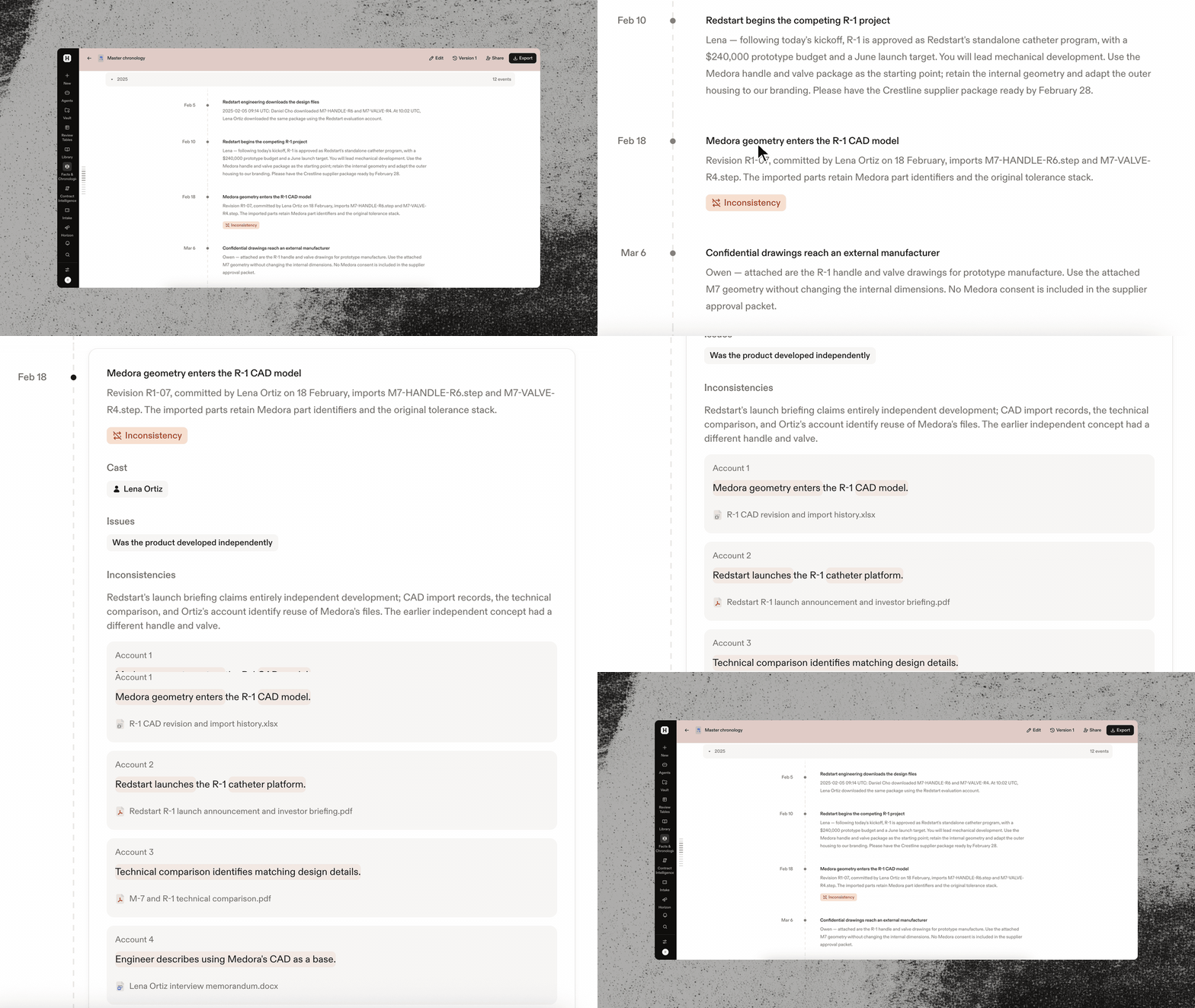
Keeping the factual record current is just the foundation. Teams can also carry those facts into chronologies, witness outlines, memos, and reports. Instead of manually updating work product, Harvey keeps the context up-to-date and flags where prior work is outdated.
With the fact graph, teams build work product on the same evolving record throughout the life of a matter. Agents in Harvey draw on the facts and connections already established to generate first drafts, from witness interview outlines early in an investigation, to deposition memos as evidence builds, to preparation materials for a hearing or trial. Each stage builds on the team’s accumulated understanding, so no one has to reconstruct the factual context for each new task.
Build on Prior Work as Your Matter Progresses

Matters can run for years, outlasting the teams that first worked on them. New team members join, responsibilities shift, and new counsel may come in just weeks before trial. Getting up to speed often means reviewing documents again, piecing together earlier analysis, and relying on handoff conversations to understand what the team knows and why.
The fact graph keeps the matter’s facts, supporting sources, review decisions, and work product together, so understanding persists through every phase of the matter. Incoming teammates or counsel can easily trace the audit log, see how the team assessed earlier information, and identify inconsistencies.
Every member of the team has a starting point that reflects months or years of accumulated work, so they spend less time reconstructing the matter and more time preparing for what comes next.
The Next Chapter for Disputes, Litigation, and Investigations
The Harvey fact graph is a new capability, enabling workflows for litigation and investigations teams. Litigators make up a third of Harvey’s customer base. They already use Harvey today, but often run into a cold start problem of rebuilding connections each time, keeping work product current, and reframing the strategy as matters evolve. The fact graph is a dedicated capability just for these workflows. It’s the foundation that stays current through every stage of a matter, so teams can spend more of their time on strategy and judgment.
We’re developing these capabilities with design partners likeSlaughter and May, to address these challenges with a dedicated new offering.
“Our disputes and investigations lawyers are trusted by our clients globally with their most complex matters, where deep expertise and judgement are critical. Working with Harvey as a design partner gives us the opportunity to combine the breadth and depth of our experience with their technology expertise to shape tools to deliver effectively what our clients need.”
Richard Jeens
Disputes Partner and member of the firm’s Innovation Committee, Slaughter and May
The Harvey fact graph is a new way to organize, connect, and work with the facts of a matter. Early Access opens soon, with more to come for disputes, litigation, and investigations teams.
Sign up for Early Access to the new disputes, litigation, and investigations capabilities.


