


How Deutsche Telekom and Gleiss Lutz are Setting the Direction for Legal Collaboration With :Harvey:
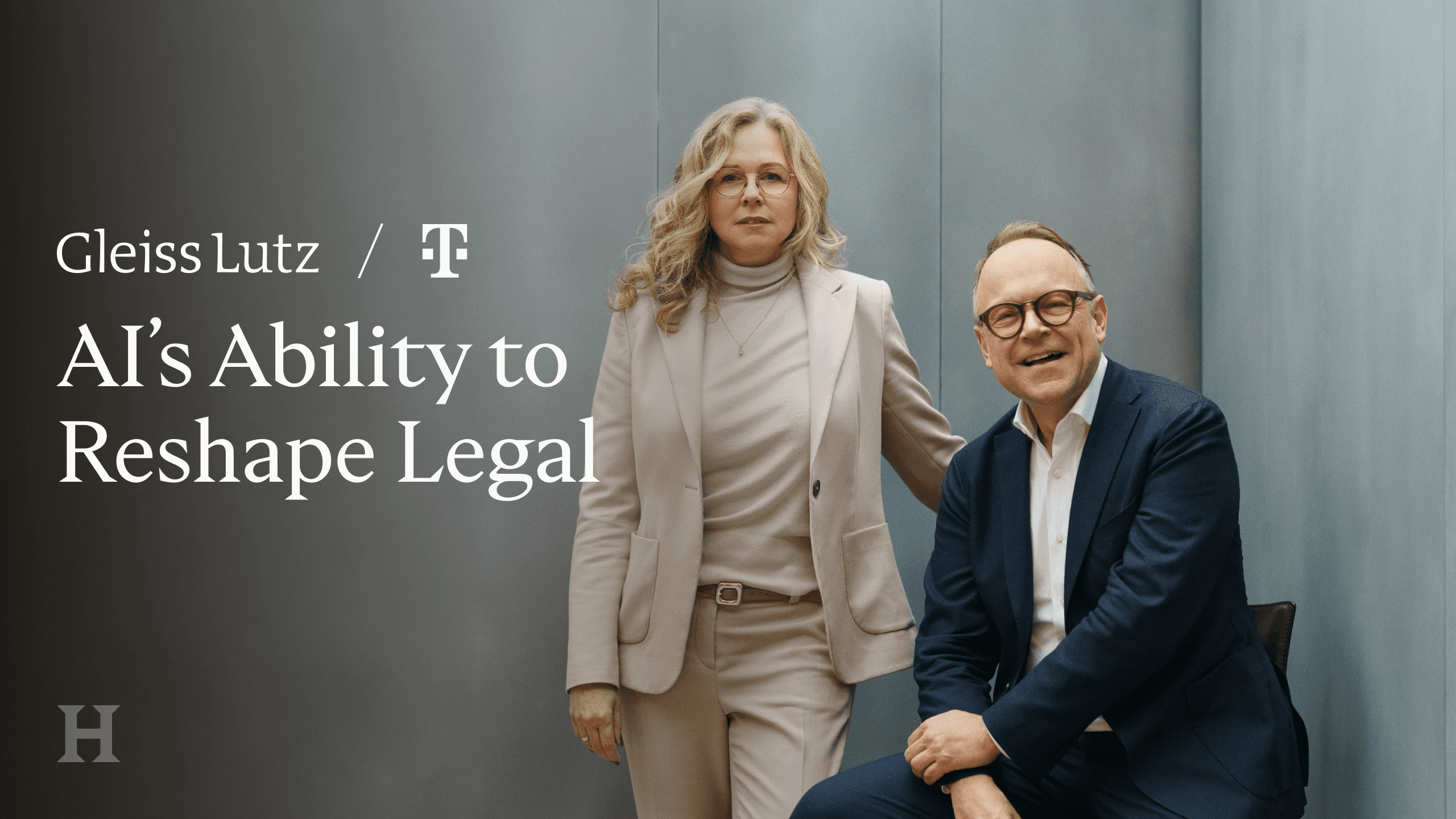
“:Harvey: doesn’t replace legal judgment. It creates the trusted foundation that lets senior lawyers focus on what actually matters: strategy, risk, and decisions”
Dr. Claudia Junker
General Counsel, Deutsche Telekom
About Deutsche Telekom
Deutsche Telekom is one of the world’s leading integrated telecommunications companies, operating across multiple jurisdictions in a highly regulated, fast-moving environment. Its legal organization supports complex commercial, regulatory, and transactional work at global scale.
As General Counsel, Dr. Claudia Junker leads a team responsible not only for managing risk, but also for enabling the business to move decisively in an increasingly complex world.
About Gleiss Lutz
Gleiss Lutz is one of Germany’s premier full-service law firms, providing integrated advice to leading enterprises on all aspects of business law, especially on high-stakes mergers and acquisitions (M&A), corporate, litigation, and regulatory matters.
Dr. Ralf Morshäuser is an M&A partner and Co-Managing Partner. He helps shape the firm’s strategic direction and how it prepares lawyers to deliver value at the highest level.
Opportunity
The legal profession is at an inflection point. Complexity is accelerating, expectations are rising, and the gap between high-value legal judgment and commoditized work continues to widen.
For Deutsche Telekom and Gleiss Lutz, two of the most influential institutions in Germany, this shift demanded more than incremental improvement. It required a clear position on how legal work should be done and how in-house teams and law firms should work together going forward.
Their conclusion was clear. The future of legal work depends on deeper collaboration built on shared context, trust, and judgment, not fragmented tools or parallel workflows.
Solution
A Shared Reality: Legal Work at Market Speed
“The market doesn’t sleep. Competitors don’t sleep,” says Morshäuser.
Both Dr. Morshäuser and Dr. Junker observed similar pressure points across their organizations. Senior lawyers were spending a considerable amount of time on first drafts, document review, and repetitive analysis. Due diligence absorbed energy better spent on judgment and negotiation. Collaboration relied heavily on fragmented systems - emails, tracked changes, and version control - creating friction at critical moments.
“At the same time,” Junker explains, “expectations keep increasing. Legal teams have to move faster, but we cannot compromise on trust or quality.”
Trust First: Privacy and Security as the Foundation
Before adopting Harvey in early 2024, Deutsche Telekom conducted a full privacy and information security assessment of the platform.
“Our data is encrypted and stored in Germany,” Junker explains. “That is a condition without which we would not do this. These are business secrets and lawyer secrets. Privacy and security are the foundation. Without them, using AI and collaboration is impossible.” After thorough evaluation, the team confirmed that Harvey's enterprise security architecture met Deutsche Telekom's rigorous standards.
“Our data is encrypted and stored in Germany. That is a condition without which we would not do this. These are business secrets and lawyer secrets. Privacy and security are the foundation. Without them, using AI and collaboration is impossible.”
Dr. Claudia Junker
General Counsel, Deutsche Telekom
That confidence extends to the law firm as well.
“We feel safe working with Harvey,” Morshäuser says. “Without a solid foundation in data privacy and legal‑profession regulations, using Harvey would not be possible.”
A Clear Position on AI
Neither leader views AI as a trend or an experiment.
“It’s not an option for lawyers today to refuse to use AI – all the lawyers in the Law & Integrity team at Deutsche Telekom use Harvey,” Junker says. “The real question is whether you use it responsibly, securely, and in a way that genuinely improves legal work.”
At Gleiss Lutz, that belief translated into firm-wide adoption. Morshäuser personally sponsored the initiative, making AI part of everyday legal practice rather than a side project.
“Today, a very good associate uses Harvey two or three hours a day,” he says. “They draft clauses, review due diligence reports, and spot issues. Harvey accompanies us in our daily work. It allows us to concentrate on what matters most to our clients: sophisticated strategic advice.”
From Parallel Work to Shared Context
Deutsche Telekom and Gleiss Lutz have worked closely together for years, often drafting documents side by side and collaborating in real time on complex matters. As individual Harvey users for years, both organizations embedded AI deeply into their workflows and recognized that the natural evolution was to bring that same collaboration into Harvey itself.
“I made a strong case internally that we could raise collaboration to the next level,” Junker says. “By organizing our work by subject matter and enabling teams across countries to build on the same materials instead of starting from scratch.”
For Deutsche Telekom and Gleiss Lutz, collaboration works because both sides operate at the same level.
“Large German corporate legal departments have lawyers who are as strong as those at top law firms,” Morshäuser says. “That’s why collaboration works so well. When both sides operate at the same level, technology and AI make it easier to work on the same wavelength.”
“That’s why collaboration works so well. When both sides operate at the same level, technology and AI make it easier to work on the same wavelength.”
Ralf Morshäuser
Co-Managing Partner, Gleiss Lutz
That shared capability creates the conditions for a different model of collaboration. Instead of treating in-house teams and external counsel as separate lanes, both organizations see an opportunity to work from a shared foundation in Harvey, with clearer context and fewer handoffs.
The goal is to move away from fragmented workflows built around emails, markups, and version control. Over time, teams aim to reduce friction by building on the same materials, adapting them across jurisdictions, and developing shared legal reasoning.
“It’s about reducing friction,” Morshäuser says. “Reducing misunderstandings. Making communication lines straighter so you don’t need to pick up the phone every five minutes.”
“The future is not sending documents back and forth,” Junker adds. “It’s working in the same space, on the same material, with shared understanding.”
Harvey supports this shift by providing a trusted foundation - its Shared Spaces functionality - where context can accumulate over time and legal judgment can scale across teams.
How Harvey Is Used Today
Today, both organizations rely on Harvey across high-value legal workflows.
“For me, it’s the first mile,” Morshäuser explains. “If I need a first orientation in an unfamiliar legal area, I ask Harvey. It gives me 85% to 90% of the answer, offering immediate and reliable guidance.”
Junker uses Harvey in the same way.
“As a General Counsel, I have questions in fields of law I have never encountered before,” she says. “I start with Harvey, get an answer, and then go deeper.”
Across teams, Harvey supports contract analysis and risk identification, due diligence and issue spotting, and board-level summaries and decision support.
“In every case,” Morshäuser says, “Harvey helps us focus on the legal questions that matter most to our clients.”
Impact
AI has not reduced the value of senior lawyers. It has clarified it.
“The law itself may become more commoditized,” Junker says. “But the ability to connect the dots and ask the right questions will not.”
Morshäuser agrees.“The value of senior lawyers will increase because judgment, experience, and relationships matter even more.”
“If you took Harvey away tomorrow,” Junker says, “it would be like taking away the car or the calculator. It would be a major step backward.”
Next comes deeper collaboration. Shared Spaces. Shared workflows. Shared context that allows in-house teams and law firms to operate as one when it matters most.
Their experience points to a clear direction for the profession. The future of legal work belongs to teams that collaborate seamlessly, think strategically, and build on trusted foundations.
Harvey is helping define that future.