


The Two Vectors Shaping Legal AI's Next Big Shift
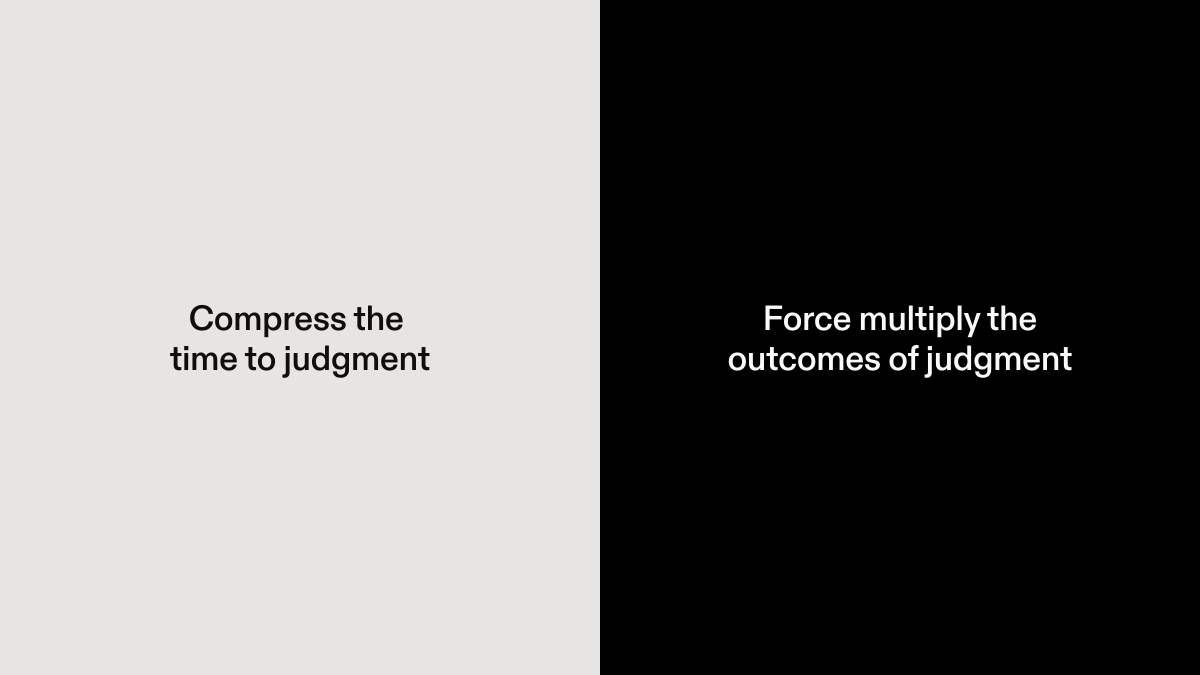
Compress the time to judgment. Force multiply its outcomes. These two vectors will determine winners in a trillion-dollar legal services market restructuring.
From Harvey FORUM to Legalweek, conversations with law firm leaders keep converging on the same question: How does AI impact our business — not in theory, but in practice?
The answer comes down to two key vectors: Compress the time to judgment. Force multiply the reach of judgment.
1. Compressing the Time to Judgment
Clients have always paid for judgment. They’ve just historically had to subsidize the time required to get there.
Lawyers sifted through documents in physical data rooms (often windowless or in basements…), compared documents side by side with a red pen, and indexed through thousands of pages before real analysis could begin.
Each wave of technology compressed the time to the moment where judgment needed to be exercised. Digital data rooms replaced the physical ones. Word processing replaced the red pen.
AI follows the same pattern, but at an unprecedented scale. What once required days of synthesis can now happen in minutes. The upstream friction between information and insight is collapsing. We’ve seen this pattern before, but never at this speed or scale.
2. Force Multiplying the Reach of Judgment
The second vector begins once judgment has been formed. Historically, a firm’s best thinking could only travel so far. A senior lawyer’s approach was applied to one matter, one set of documents, one client at a time. AI breaks that constraint.
A judgment call that once informed a single workstream can now cascade across dozens. Institutional knowledge can be embedded into workflows, replicated instantly, and deployed consistently. The reach of expertise expands beyond the bandwidth of any individual lawyer or team.
What History Suggests
If history is any guide, compression does not necessarily mean contraction. Over the past few decades, each wave of legal technology made work more efficient. And yet… legal fees didn’t fall. They rose. Substantially.
Major firms have demonstrated meaningful pricing power, raising rates at roughly twice (or more) the rate of inflation. A recent Wall Street Journal headline captured the dynamic well: “Top Lawyers’ Fees Have Skyrocketed. Be Prepared to Pay $3,400 an Hour.” Why didn’t efficiency translate into lower cost for clients? Why did technological gains coincide with rising rates instead of falling ones?
Because each wave of efficiency was absorbed into expanded scope.
Word processing didn’t make contracts shorter — it made them longer and more comprehensive. Digital data rooms didn’t reduce diligence — they broadened it. The time saved via technology was reinvested into deeper review, more scenarios, more contingencies. What was once considered exhaustive became standard. The new baseline invited even more refinement, more documentation, and longer negotiations. A second-order expansion of scope layered on top of the first.
Why This Wave is Likely Different
This shift will likely follow a different trajectory. Structural conditions are radically changing, as the first vector (compressing time to judgment) accelerates exponentially. Additionally, clients are no longer passive participants.
On one hand, as outside-counsel rates have climbed, corporate legal departments have become sophisticated managers of legal spend. E-billing systems, benchmarking data, structured rate reviews, and matter analytics give them visibility into workflows that did not previously exist.
On the other hand, clients now have access to the same class of AI tools. The underlying production technology is no longer exclusive to law firms. Corporate legal teams can test, experiment, and evaluate what parts of legal work can be accelerated or automated themselves.
Together, these dynamics shift the equilibrium in a way that differs materially from prior technology waves. In the past, firms largely captured the gains from efficiency. Today, both sides of the market are equipped. Who captures the value?
The Market Consequence
The global legal services market is estimated at $1.12 trillion in 2024 and projected to reach $1.86 trillion by 2034. Legal work is becoming more complex.
As the first vector compresses time to judgment, the second vector — multiplying the reach of that judgment — determines how much new ground firms can claim. And over the past two decades, meaningful ground has shifted. Clients have brought more work in-house. They’ve turned to alternative legal service providers for process-heavy matters. They’ve unbundled work that once defaulted to outside counsel.
Those segments are not permanently lost. They are economically sensitive. When judgment becomes both faster and more scalable, previously offloaded work becomes contestable again.
The firms that master both vectors won’t simply defend share within that market. They will expand it — reaching mid-market clients who couldn’t justify premium hourly rates, profitably serving routine matters that once required uneconomical associate leverage, reclaiming work that migrated in-house or to ALSPs, and enabling high-velocity clients like private equity sponsors to operate at new speeds.
Consider a repeat private equity client that has always wanted same-day initial diligence red flags. Previously impossible, now feasible.
This doesn’t replace full diligence. It creates new value at the top of the funnel — accelerating letters of intent, screening more opportunities, increasing deal velocity. The client may pursue more transactions precisely because diligence friction has fallen.
What We’re Building
Harvey is building around those two vectors.
AI has already begun compressing the time to judgment. We will push this further with innovations like persistent memory — carrying forward context, matter details, firm precedent, and best practices across workflows — and more robust agents, including long-horizon agents, that orchestrate multi-step reasoning and task automation at scale.
Importantly, through Shared Spaces, we multiply the reach of judgment by embedding institutional expertise into systems that scale across matters and across the full stack of judgment a client may need.
We are already seeing this in action across our law firm and client partnerships, where shared workflows are accelerating insight, tightening feedback loops, and extending a firm’s best thinking across more matters than was previously possible. In many cases, this collaboration is surfacing new layers of judgment that neither side would have fully anticipated at the outset.
The firms that move early won’t simply operate more efficiently. They will change what kinds of work are possible — at what speed, at what scale, and at what price point.
The “End of the Billable Hour!” has been a perennial conference panel topic. What we’re seeing now is less theoretical and (not so shockingly) more nuanced: Shared Spaces are creating the operational foundation for firms to offer fixed-fee structures, subscription advisory models, and value-based pricing strategies that were previously difficult to sustain. It’s not the end of the billable hour as we know it, but things have certainly become more interesting.
Opportunity abounds. We look forward to continuing to partner with the industry to expand the frontier of judgment.


