


PwC’s AI-Driven Approach to Legal Entity Transformation
How PwC and Harvey are collaborating to enhance the speed and quality of legal entity strategy.
Legal entity structures underpin every major M&A transaction, yet for years they’ve been managed through labor-intensive, checklist-driven processes that often slow progress and obscure insight. At PwC, that paradigm is shifting.
Emma Cray, a Partner in PwC’s Deals team, is driving practical changes in how entity lifecycle work is carried out. By pairing deep expertise with AI-driven automation and analysis through PwC's alliance with Harvey, she and her team are able to uncover insights earlier, accelerate delivery, and make entity simplification and integration more predictable and consistent.
To explore how this transformation is unfolding in practice, we spoke with Emma about her role, her team’s use of Harvey, and the impact they’re seeing across engagements.
Can you tell us about your role within the Deals team and what your day-to-day work typically involves?
I lead our Legal Entity Optimisation practice within Deals. In simple terms, my remit is to ensure clients’ legal entity structures are fit for purpose both for today and the future. The right structure can support strategy, reduce cost and compliance burden, and enable value-creating transactions.
My work spans large‑scale global simplification programmes, UK members’ voluntary liquidations (MVLs), carve‑out readiness, and post‑deal integration, with a primary focus on client delivery. I scope and steer cross‑border projects, sign off pre‑elimination reviews in my capacity as proposed liquidator, and ensure governance, risk, and sequencing remain on track. I also work closely with my team to design and develop solutions that transform how we deliver this work to clients.
How do you see (or are already seeing) AI transforming M&A and professional services?
The big shift for us is from checklists to insight. Historically, we’ve asked for the same information to progress a workstream. With Harvey, we can review far broader datasets like accounts, public records, and ERP exports and interrogate them in a way that helps to identify issues that might have previously been overlooked as being below a materiality threshold. That means we can identify dependencies and arrangements that would otherwise be missed. With better information, we can deliver better planning with fewer surprises in entity eliminations, and faster progress because we understand the landscape earlier.
Crucially, this shift doesn’t just take cost and effort out of the process for PwC. It also reduces the burden on our clients, whose teams are often juggling these projects alongside their day jobs, by using data and AI to focus effort, accelerate tangible progress, and maintain the highest standards of quality and risk management.
Much of what we do in entity lifecycle work is repeatable, which means it’s perfect for automation. Our work has standard templates with well-structured inputs and well‑defined steps, so these tasks are almost tailor-made for AI‑enabled workflows. That’s why we’re now looking beyond one-off tools and starting to build end-to-end automation, where Harvey handles much of the routine execution and people focus on reviewing and signing off.
“We’re now looking beyond one-off tools and starting to build end-to-end automation, where :Harvey: handles much of the routine execution and people focus on reviewing and signing off.”
My main aim in the next few months is to ultimately automate the UK MVL process for surplus companies so we can deliver outcomes faster, more consistently, and more cost-effectively, while still maintaining the highest standards of quality and regulatory compliance. The MVL process in the UK follows a clear, prescribed sequence, both pre- and post-liquidation, so we could easily automate vast parts of the process. By building guided workflows and prompts, we are creating an end-to-end automation solution that embeds PwC’s liquidation methodology so clients benefit from a robust, reliable result.
Once the UK MVL automation is fully proven, it would be great to roll out a configurable version of the workflow to other territories. This second phase will adapt the core model to local requirements while ensuring consistent standards across markets.
What are the primary ways you and your team use Harvey today? What problems or bottlenecks are you able to solve?
Today we use Harvey on both the statutory and advisory sides of legal entity work. On statutory matters, particularly members’ voluntary liquidations, Harvey automates the pre‑elimination review by pulling key data from accounts and public sources and organising it against our regulatory requirements. We can then use Harvey to pre‑populate what historically were manual templates, saving time for both us and our clients. This level of automation eliminates repetitive and expensive manual data extraction and re‑keying — ensuring greater consistency and faster sign‑offs.
On advisory and global projects, we’re gathering our collective know-how into Harvey Vault, including country step‑plans, commercial considerations, pitfalls, and sequencing realities that you can’t get from statute alone. Harvey lets us combine that proprietary knowledge with client data to produce recommendations that are more holistic and practical.
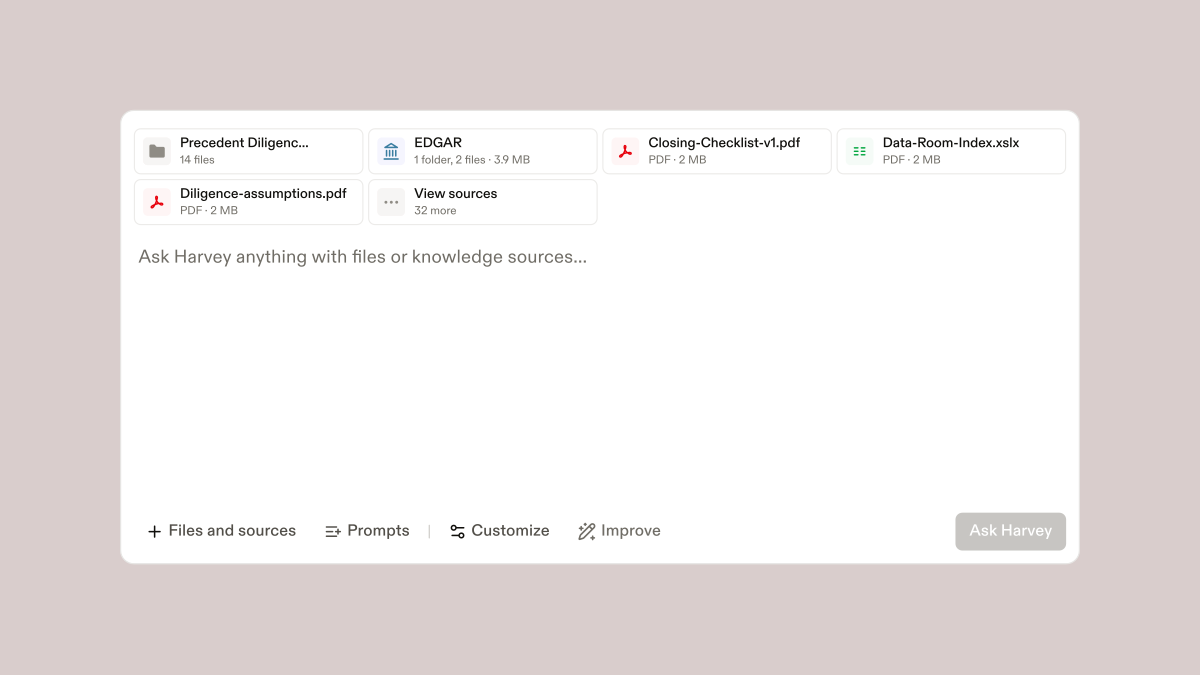
As an example, we have worked on a global, multi‑jurisdiction simplification programme that involved hundreds of entities across 40+ territories. We used Harvey to consolidate and summarise our step‑plans and key learnings in each country, then applied that context to the client’s structure and data.
Instead of just listing statutory steps, we proactively flagged commercial and regulatory friction points. Working in tandem with the client’s data and our PwC subject matter experts (accounting, tax, and legal), we assessed distribution restrictions, reporting implications, tax sequencing, and third‑party consents. This way, the client could rationally order eliminations, correctly sequence interdependent steps, and avoid rework, while mitigating the commercial and technical risks inherent in these projects.
For the MVL workstream, Harvey is helping us save time and improve consistency ahead of liquidator sign-off by extracting key fields from financial statements and other publicly available information to populate our internal briefing documents. This can help us save around one to two hours per project which, at our volumes, is material.
Which parts of the Harvey platform have been the most valuable for your team, and why?
Harvey Vault has been pivotal because it allows us to capture and operationalise our proprietary knowledge that consists of country‑by‑country step‑plans, sequencing nuances, and practical considerations and then apply that consistently. The ability to ground Harvey’s outputs in our own curated content is a genuine differentiator versus generic guidance.
We also rely on Harvey’s document and data extraction capabilities to pull structured information from accounts and public filings into our gateways and templates. That’s where we see reliable, repeatable time savings. We see real potential for the future with Workflows and agents, stitching these elements together end‑to‑end and moving from task‑level accelerators to fully standardised processes with embedded reviews and audit trails.
What impact has Harvey had on productivity, time savings, quality of work, or client outcomes across the Deals team?
We’re seeing tangible time savings at the micro‑task level and these add up at scale. On a standard liquidation, Harvey saves roughly one to two hours in the pre‑elimination stage by automating data extraction and pre‑population. With 300 to 500 appointments a year, that’s a meaningful productivity gain.
“:Harvey: saves roughly one to two hours in the pre‑elimination stage by automating data extraction and pre‑population. With 300 to 500 appointments a year, that’s a meaningful productivity gain.”
Importantly, we’re reinvesting that time to go deeper on insight, surfacing previously disregarded issues and anticipating the governance and reporting impacts of structural changes. This enables us to make proactive, strategic decisions with more confidence.
Since our outputs are more consistent, quality has improved and we are less dependent on manual re‑keying, helping to reduce avoidable error and accelerate sign‑offs. For clients, the experience is faster responses and fewer surprises, which in turn helps accelerate deal and simplification pipelines. Internally, the standardisation that Harvey enables is allowing us to scale capacity without compromising governance, and it strengthens our ability to differentiate in proposals by bringing practical, data‑driven insight rather than just statutory process.
What advice would you give other M&A or professional services leaders who are considering adopting AI tools like Harvey?
Start where the work is repeatable and the rules are clear, then build outward. Codify your playbooks, step‑plans, and red flags in a knowledge base so you’re operationalising your firm’s real‑world experience, not just statute and regulation. Use early time savings to fund the deeper analytical work that clients actually value, and measure those micro‑wins because they compound quickly at scale.
Treat this as both a technology and a standardisation programme. The more you standardise inputs, outputs, and reviews, the more benefit you’ll see. In transactions, capture critical data at acquisition so you preserve corporate memory for integration or retirement later and keep humans in the loop where judgment matters. AI can execute the steps but your teams provide the context and challenge, which is ultimately what gives your clients confidence.
Finally, be ambitious about end‑to‑end automation of the commodity layers of your service; it frees your best people to focus on higher‑value problems and ultimately delivers better outcomes for clients.


