



Harvey FORUM: From Piloting AI to Operationalizing it
Leaders explored how AI is reshaping workflows, knowledge infrastructure, and the future of legal work.
At this year’s Harvey FORUM New York, the conversation around AI in legal felt notably different than it did even a few months ago. Across both days, conversations reflected an industry moving quickly from experimentation to implementation, with legal leaders focused on how AI is reshaping workflows, governance, knowledge infrastructure, and the structure of legal organizations themselves.
Similar to Harvey FORUM London in February, last week’s event included two days, each focused on different parts of the legal ecosystem. Law Firm & Innovation Day centered on how AI is changing client expectations, firm economics, talent strategy, and the operational realities of adoption at scale.

In-House Day explored how legal departments are integrating AI into everyday work through responsible AI governance, Legal Ops leadership, workflow redesign, and cross-functional collaboration.
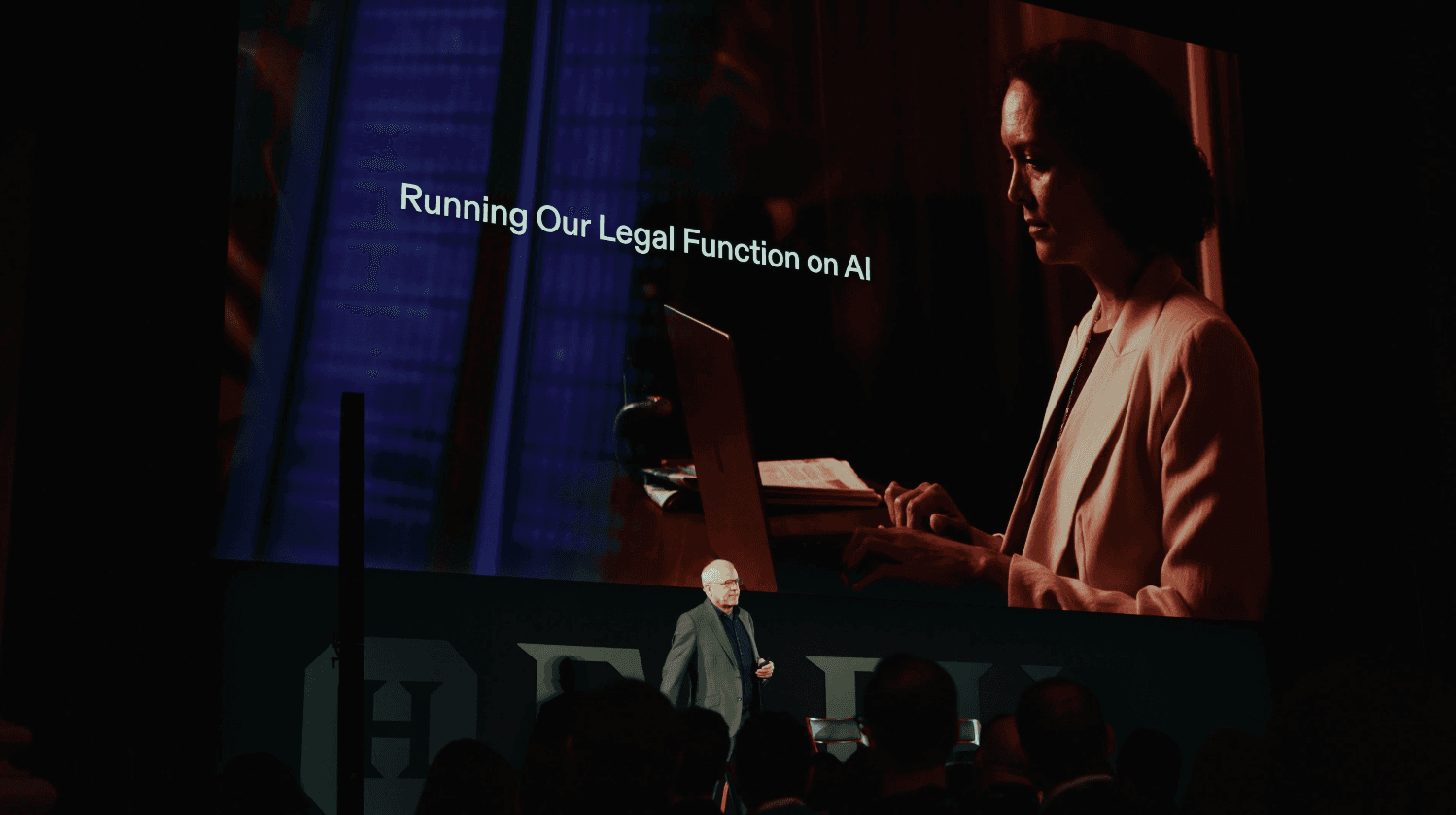
Throughout the keynotes, panels, and breakout sessions, common themes surfaced across both audiences. Below are five takeaways that stood out from Harvey FORUM New York.
1. From AI Assistants to AI Agents
Legal organizations are moving beyond AI assistants and toward AI agents capable of planning, executing, and reviewing increasingly complex legal workflows. During the opening keynote, Harvey CPO Anique Drumright described this shift as a fundamentally different way of interacting with AI. With Harvey Agents, work is delegated to systems that can take a legal task from goal to deliverable, and the lawyer reviews, guides, and approves the work along the way.
Agents also offer a way to build and customize workflows around an organization’s own internal processes, knowledge, and ways of working. Karen Buzard, Partner at A&O Shearman, shared that after the firm rolled out Agent Builder internally, they quickly saw dozens of agentic workflows being built across practice groups. On the in-house side, Harvey General Counsel John LaBarre described a future where lawyers move from doing repetitive work themselves to orchestrating systems of agents and workflows that they review. He noted, “My directive for my team is going to be: How many agents can you have up and running at any given time?”

As agents become more embedded in legal work, conversations turn to how their performance should be evaluated in real legal environments. Harvey CEO Winston Weinberg shared updates on the company’s Legal Agent Benchmark (LAB), an open-source benchmark developed with research partners across the AI ecosystem. Weinberg emphasized that performance varies significantly by model and practice area, reinforcing the idea that many legal workflows will increasingly rely on a mix of specialized models rather than a single system for every task.
2. AI Adoption Needs Visibility
As adoption accelerates, many firms are facing the challenge of understanding how AI is actually being used inside their organizations.
During Law Firm & Innovation Day, Harvey leaders introduced Command Center, an intelligence layer for Harvey deployments that gives admins visibility into adoption trends, engagement patterns, and areas where additional training or support may be needed. It also includes peer benchmarking based on anonymized data from Harvey customers, helping firms see how adoption differs across practice groups, offices, and user cohorts, and compared to similar organizations.
“[Command Center] is so phenomenal in so many ways, including the leaderboard that not only shows your employees rankings, but against peer firms that you choose.”
Kelly Boyd
Of Counsel at Foley & Lardner
The need for greater visibility into adoption and behavior change surfaced throughout the day’s sessions on rollout strategy and transformation at scale. Speakers discussed the importance of practice-group-specific training, peer-driven adoption, and identifying pockets of resistance early. Kelly Boyd, Of Counsel at Foley & Lardner, highlighted how visibility can also create momentum, pointing to Command Center’s leaderboard functionality as a way to encourage engagement and healthy competition across teams and peer firms.
Throughout FORUM, the conversation around adoption consistently returned to the same idea: as AI becomes more embedded in everyday legal work, firms need better ways to understand, measure, and scale its impact.
3. GCs are Leading AI Transformation
Legal departments are increasingly taking on a broader role in how organizations adopt, govern, and scale AI. Throughout In-House Day, sessions on responsible AI, Legal Ops, and the evolving role of the General Counsel explored how leaders are balancing governance, operational change, and business strategy as AI adoption accelerates. Speakers described legal teams as uniquely positioned to guide enterprise AI adoption because of their visibility across the business and their responsibility for managing risk.

Vandana Venkatesh, Executive Vice President and Chief Legal Officer at Verizon, described AI as a tool for “automating administrative work to augment judgment,” while Athenahealth Chief Legal Officer Jessica Collins noted that legal leaders are increasingly expected to act as business transformation leaders, not just providers of legal advice.
“As a team we’re talking about automating administrative work to augment judgment. I think that’s really critical and enables our lawyers to do what they do best.”
Vandana Venkatesh
Executive Vice President and Chief Legal Officer at Verizon
The theme also surfaced in Harvey’s announcement of Contract Intelligence, a system designed to help in-house teams manage every contract flowing through their business. It will enable legal teams to take a more strategic approach to contract review, negotiation, and analysis by adapting to their playbooks, risk appetite, and negotiation patterns — continuously improving with every executed agreement.
4. Knowledge Infrastructure is a Strategic Advantage
Across both days of FORUM, speakers emphasized that AI is only as effective as the knowledge and data it can access. Conversations around knowledge management, institutional data, workflows, and precedent systems highlighted a key insight: firms and in-house teams with well-organized knowledge infrastructure are moving faster and getting better results from AI.
On the law firm side, speakers discussed how years of investment in knowledge management are becoming increasingly valuable in the AI era. Adam Ziegler, Director of AI, Legal Innovation at Latham & Watkins, noted that much of the groundwork for AI readiness had already been laid by KM professionals long before generative AI arrived. Tania Djerrahian, Senior Director of Innovation and Knowledge Management at Davies, emphasized that “data quality is what grounds the technology” and makes AI systems more effective and easier to use.

Similar ideas were shared throughout In-House Day, where discussions focused on the importance of getting workflows, templates, precedents, and institutional knowledge into AI systems in a usable way. Speakers emphasized that organizations with stronger data, clearer processes, and better-organized knowledge infrastructure will move significantly faster with AI.
Harvey’s announcement of its partnership with DeepJudge reflected the growing importance of connected knowledge systems and enterprise-wide retrieval. As AI adoption accelerates across the industry, the ability to surface the right knowledge, context, and prior work product is becoming a competitive advantage for law firms and in-house legal teams.
5. AI Success Depends on People
While much of FORUM focused on AI workflows, agents, and infrastructure, another theme surfaced just as consistently across both days: AI transformation ultimately depends on people.
At Law Firm & Innovation Day, discussions centered on training, culture, and adoption. Speakers emphasized that practice-area-specific training, peer storytelling, and visible wins are often more effective than top-down mandates. Shonette Gaston, COO at Blank Rome, noted that “AI is not just technology management but culture management.” Firms also shared how they are redesigning associate development, champion programs, and rollout strategies to make AI adoption sustainable over time.

In-house legal leaders repeatedly emphasized that the hardest part of AI transformation is not the technology itself, but getting people to change how they work. Discussions focused on the importance of peer learning, visible wins, hands-on training, and making AI feel relevant to day-to-day workflows. Several speakers also stressed the importance of empathy as lawyers navigate uncertainty around how AI is changing the profession, with the most successful organizations focused on bringing people along rather than forcing change top-down.
Across both days of FORUM, the conversations reflected a broader shift in how the industry thinks about AI transformation. The most successful legal teams are investing heavily in training, experimentation, and organizational buy-in to drive lasting behavior change — creating more space for lawyers to focus on judgment, strategy, and the uniquely human aspects of legal work.


