


Building in Active Guardrails With GPT-5.2
How we’re using GPT-5.2 to create proactive guardrails for complex legal work.
We are excited to announce the launch of GPT-5.2 and its availability on the Harvey platform. This new model represents a significant evolution in how AI interacts with complex legal tasks, combining frontier reasoning with a stronger inherent understanding of its own operational boundaries.
During the early-access period, GPT-5.2 demonstrated impressive performance across Harvey’s core product surfaces and our BigLaw Bench evaluation (89.8%). What stands out, though, is not just the model’s raw performance, but its capability awareness — the model is much better at knowing what it can do, what it can’t do, and when it needs more information before moving forward.
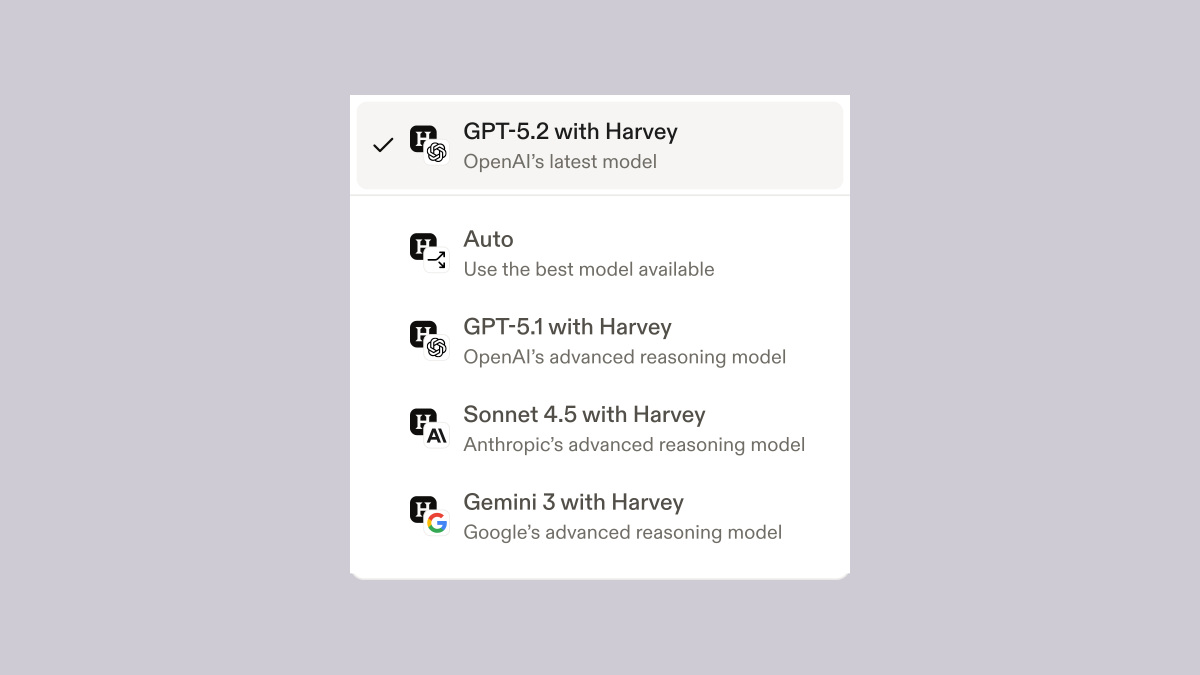
In this post, we’ll share how GPT-5.2 is helping Harvey evolve into a more self-aware legal collaborator; one that can reason about guardrails, uncertainty, and information gaps while still delivering the performance and usability that our customers expect.
Trust Through Transparency
As AI systems take on more substantive work, the question of trust becomes paramount. Law firms and their clients alike need assurance that AI-assisted work products meet professional standards, not just in their final form, but in how they were produced.
“When GPT-5.2 surfaces a constraint, it creates an opportunity for human judgment at precisely the moment it matters most.”
GPT-5.2's ability to reason about its own limitations represents fundamental progress toward this goal. When the model surfaces a constraint, it creates an opportunity for human judgment at precisely the moment it matters most. Rather than discovering issues downstream in review, lawyers can address them at the point of delegation.
Building in Guardrails
The most critical shift in GPT-5.2 is its movement from passive execution to active guardrails. In complex legal matters, trust is built not just on knowing the answer, but on knowing whether an answer is possible given the current constraints.
Previous generations of models, though similarly strong in terms of raw reasoning, might attempt to execute impossible tasks — such as producing a 40-page document in a single turn or generating a PowerPoint file without the necessary tools — often leading to hallucinations or silent failures. GPT-5.2 possesses a stronger inherent understanding of these limitations. Instead of failing silently, GPT-5.2 proactively raises these constraints to the user. It reasons about the request, identifies the gap between the goal and the available resources, and communicates that uncertainty.
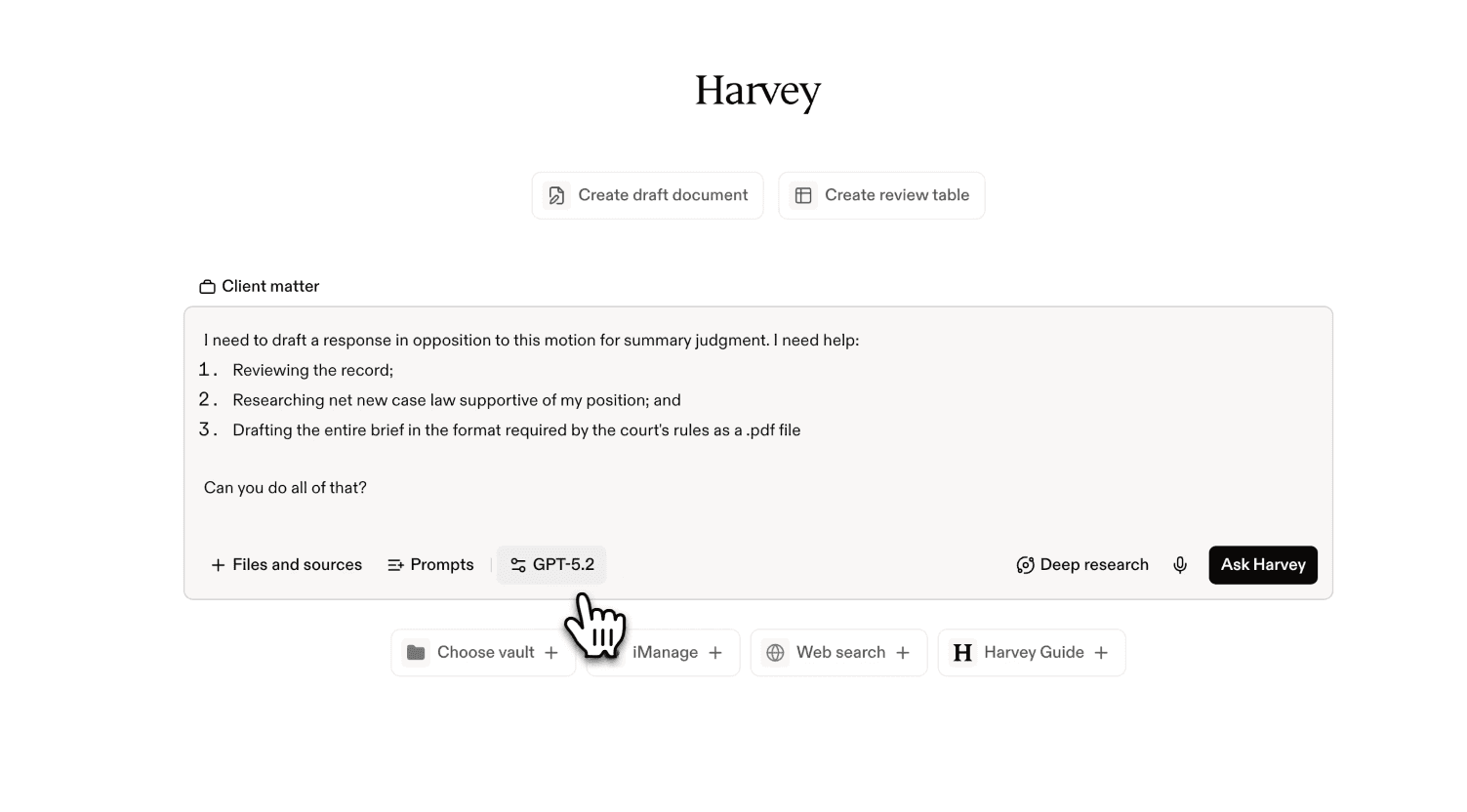
This ability to reason about impossible or difficult tasks ensures that the model acts as a transparent partner, flagging potential roadblocks before they become errors.
Trustworthy Reasoning at Scale
Combined with Harvey's existing transparency features — citations, thinking states, and human-in-the-loop workflows — GPT-5.2 strengthens the foundation for AI that earns trust through appropriate epistemic humility rather than false confidence. It shifts the dynamic from a user simply prompting a tool to a professional directing a coworker who knows when to ask for clarification.
This enhanced "meta-cognition" — the ability for the model to think about its own thinking — lays the groundwork for safer, more reliable legal workflows. This vision rests on three key pillars observed during our review:
- Proactive Guardrails: The model is far less likely to attempt tasks that exceed its context window or tool capabilities, preferring to guide the user toward a feasible alternative.
- Transparent Sourcing: GPT-5.2 performs better than prior models on citation generation, a behavior that correlates strongly with improved context recall and passage relevance. This ensures that when the model speaks, it can point clearly to the evidence.
- Structural Integrity: By strictly adhering to clear formatting standards — even maintaining section breaks to compartmentalize complex ideas — the model reduces ambiguity and improves the readability of long-form analysis.
What’s Next
With GPT-5.2, we are moving closer to an AI coworker that doesn't just execute commands, but understands the parameters of success. By building in guardrails and reasoning about uncertainty, we empower lawyers to deploy AI with greater confidence on their most critical matters.
We’ll be rolling out GPT-5.2 in the model selector to eligible clients in the US over the next 24 hours and in the EU when it becomes available. We look forward to seeing how these new capabilities enhance your practice.


