


How Legal Teams Use AI Tools for Contract Generation and Automation
An AI contract generator builds first drafts from your approved playbook and precedent, not generic templates, so in-house legal teams reach review faster.
Legal teams can generate contracts with AI, review language, identify issues, and manage the steps that move an agreement toward execution. However, the expanding capabilities of AI tools have also created some confusion around terminology. Contract generation and contract automation are two terms you’ll often see used interchangeably across the market, even though they serve different purposes.
An AI contract generator produces a first draft of a new contract from a description of the deal. AI contract automation, on the other hand, refers to the workflow around drafting, review, approval, and execution. Understanding this difference becomes particularly important when deciding which tool to apply to which problem. Teams that expect generation to solve workflow problems, or automation to produce a better first draft, see the implementation underdeliver.
The quality of the drafted contract also largely depends on whether the AI draws from generic legal training data or your organization’s own contract playbook and precedent.
Generation vs. Automation, a Category Correction
AI contract generation and contract automation can both save time, but at different stages of your contract drafting process. Contract generation focuses on creating the first draft from the details of a deal, while contract automation manages the workflow around that draft, including review, approvals, and execution. Keeping this distinction in mind makes it easier to understand what to expect from each type of tool.
When you use an AI contract generator, you give the AI the key details of the deal: what you’re drafting, who the parties are, which jurisdiction applies, and the commercial terms you’ve agreed on. The AI uses those inputs to produce a first draft, and the quality of that draft depends on the source material it draws from, including your contract playbook, clause library, and precedent bank.
With the right source material, AI contract drafting software can incorporate approved positions and fallback language directly into the first draft, reducing the amount of standard language lawyers need to revise or pull from past agreements before review begins.
AI contract automation addresses a different part of the process. It routes drafts to reviewers, manages approvals, tracks status, and connects contract data with CLM systems and downstream analytics. Those capabilities can keep the process moving, but the amount of legal work required during review still depends heavily on the quality of the draft entering that process.
AI contract automation addresses a different part of the process. It routes drafts to reviewers, manages approvals, tracks status, and connects contract data with CLM systems and downstream analytics. Those capabilities can keep a contract moving after drafting, but they don’t determine how much legal work the first draft will require. That depends on the inputs and guidance used to generate it.
What Playbook-Grounded Generation Actually Means
Playbook-grounded generation produces first drafts using your organization’s approved clauses, fallback positions, and negotiated limits rather than relying on generic legal training data. This gives the AI a clear set of rules for how your team approaches a particular type of contract.
Your team can define those rules in the contract playbook. This includes your approved standard positions, acceptable fallback ranges, and non-negotiables. In Harvey, Playbooks give the AI that guidance during drafting, so the first draft can reflect the positions your team has already established.
Any change to the playbook carries into future drafts, so they reflect the updated positions as well. This keeps each draft aligned with your team’s current approach, so the drafting associate doesn’t have to work out which position or language applies each time.
This is what differentiates playbook-grounded generation from a template-based approach. A static template gives the AI a fixed document with blanks to complete, whereas playbook-grounded generation uses your organization’s legal guidance to shape the first draft itself.
With that guidance built into the playbook, here is how it shapes an actual first draft:

Anatomy of a First Draft From Precedent
First-draft generation from precedent follows four steps: define the deal, generate from relevant precedent, review what requires attention, and resolve any deviations.
Here’s how the process works.
1. Define the deal. Start by providing the key details, including the parties, contract type, jurisdiction, and commercial terms, along with any deviations from your organization’s standard positions. This gives the AI contract generator the context for jurisdiction-specific drafting and a first draft tailored to the deal.
2. Generate from relevant precedent. The AI selects appropriate precedent from your organization’s precedent bank and uses approved clauses to build the first draft. The AI flags any deal terms that fall outside your standard positions for the lawyer to review.
3. Review what is specific to the deal. The lawyer doesn’t need to review every standard clause from scratch. Instead, they can focus on any flagged deviations and deal-specific sections that require legal judgment.
4. Resolve the deviations. The lawyer reviews each flagged deviation and decides whether to accept it, reject it, or negotiate a different position with the counterparty. Once those points are resolved, the team can finalize the contract for signature.
AI can produce a first draft in seconds, but that alone doesn’t make the entire contract process faster. The larger time savings happen during review and negotiation, when lawyers have fewer issues to work through before the contract is ready for signature.
Harvey Playbooks can also be shared between firms and clients. Shared Playbooks let both sides work from agreed positions and guidance, extending the same playbook-grounded approach across the relationship. Watch the video below as an example:
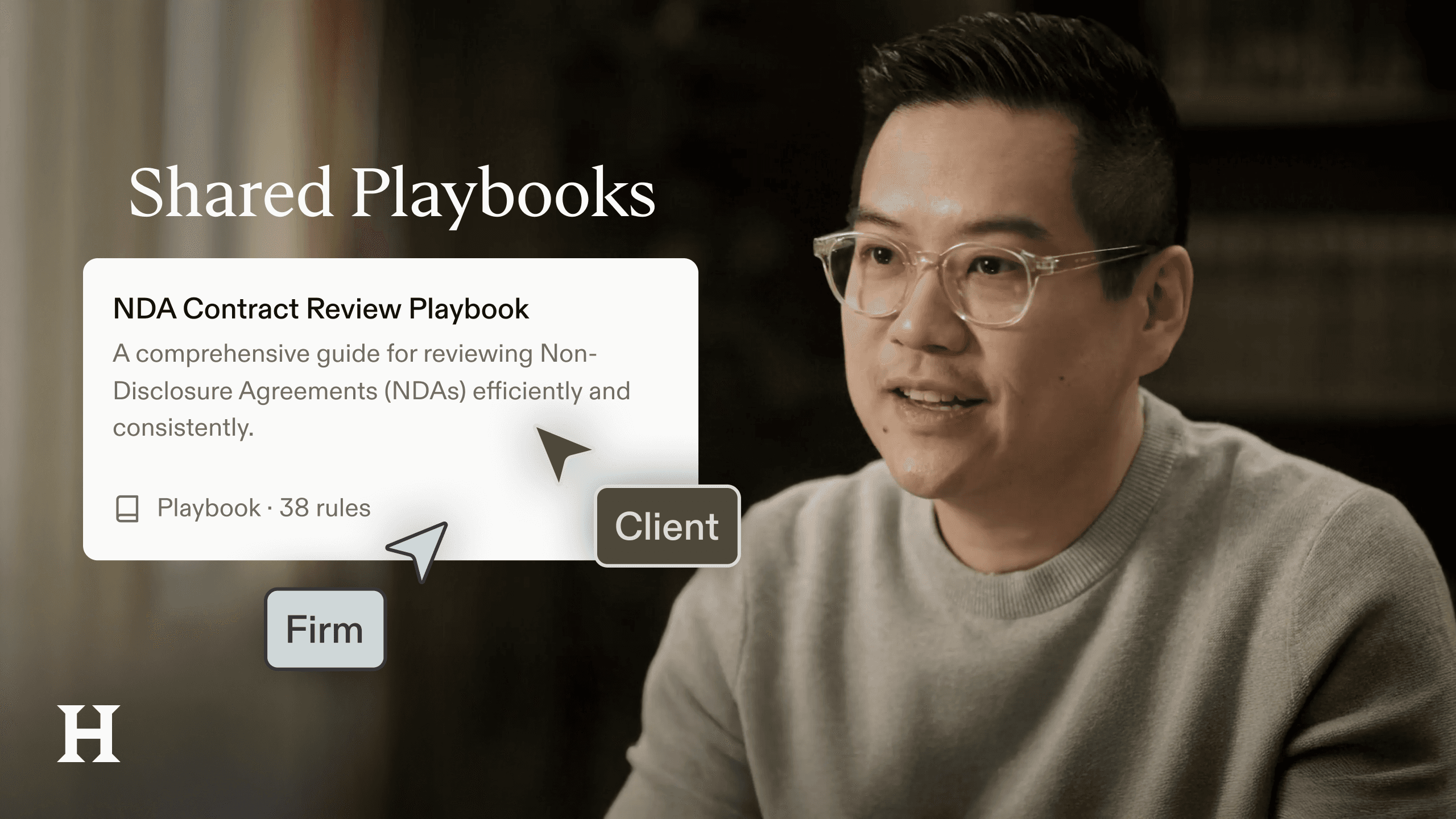
See how firms and clients use Shared Playbooks in Harvey to apply agreed positions consistently across contract work.
Where Internal Consistency Exposes Weak Generation
Internal consistency is one of the clearest indicators of how well an AI contract generator has built the first draft. In a well-generated contract, the defined terms, references, and clause logic remain consistent throughout the document, so each provision works correctly with the rest of the agreement.
On the other hand, weak generation can produce a contract that looks complete but contains inconsistent details. For example, weak generation might define the same term as “Services” in one section but use different language for it elsewhere. A cross-reference might point to Section 8 after the provision moved to Section 9 during drafting. Or a clause might depend on a condition that was removed elsewhere in the agreement.
These may seem like small drafting errors, but lawyers still need to trace and correct each one. This adds mechanical cleanup to the review process and takes time away from the legal and commercial issues that require their judgment. A well-generated first draft avoids that extra work, so the time saved during generation is not lost during review.
Contract Types That Benefit Most From AI Generation
Not every contract type benefits equally from an AI contract generator. The strongest use cases are usually contracts with a repeatable structure that rely on positions the organization has already established.
High-volume contracts such as NDAs, SOWs, and procurement agreements are particularly well suited to AI contract creation because they tend to follow a repeatable structure. Their playbooks already capture approved clauses, fallback language, and common negotiation positions, leaving fewer deal-specific terms for the tool to account for. This makes it easier to produce a first draft that requires fewer changes.
Highly bespoke transactions, such as M&A definitive agreements, joint ventures, and complex financings, also benefit from a legal AI contract generator, but to a different degree. These agreements contain more deal-specific terms, so there is less scope for a playbook to determine the first draft. AI can still speed up drafting, but it often saves more time during review and negotiation, when lawyers are working through transaction-specific provisions.
Here’s how that applies across different contract types:
Contract Type | AI Generation Fit | Typical Value From AI Generation |
|---|---|---|
NDA | Very high | First draft in seconds; standard positions almost always apply |
Master services agreement | High | First draft against the org's standard positions; deal-specific SOW added separately |
Statement of work | Medium-high | Template plus deal-specific scope; playbook governs commercial terms |
Employment agreement | High | Jurisdiction and role-specific; playbook governs comp and post-term restrictions |
Distribution or reseller | Medium | Playbook governs standard terms; territory and pricing are deal-specific |
M&A definitive (SPA / APA) | Medium | First-draft acceleration matters most for lean teams; see companion piece |
The Human Loop That Matters
AI contract generation doesn’t remove the lawyer from the drafting process. It shifts the lawyer’s attention to the parts of the contract that require legal judgment.
The legal team establishes the contract playbook, reviews flagged deviations and proposed redlines, negotiates terms that fall outside approved positions, and signs off on the final agreement. With standard clauses and precedent already available to the AI, lawyers can spend less time recreating existing language, searching through previous deals, and manually checking cross-references for internal consistency.
However, the quality of the output still depends on how well the playbook is maintained. Legal positions change as teams negotiate new deals, fallback language evolves, and teams learn which terms they are willing to accept. A playbook that misses those changes leaves the AI drafting from outdated guidance, and future contracts drift from the team’s current positions.
For teams without a formal playbook, existing contract history can provide the foundation. This is often the case for Series B or C companies hiring their first General Counsel. AI can analyze signed contracts and previously negotiated positions to identify the guidance the team already follows in practice. This helps the legal team build a playbook that becomes more structured as the function develops and supports AI across the contract lifecycle.
Using AI Contract Generation to Manage Growing Contract Volume
In-house teams can apply AI contract generation whether they already have a mature playbook or are still formalizing one. Teams with established guidance can use Harvey to generate drafts from approved positions and precedent. Teams earlier in that process can use their contract history to identify recurring positions and build more structured guidance over time.
For teams managing high contract volume, that means lawyers can start routine agreements from language and positions the legal function has already approved, rather than rebuilding the same draft for each request.
See how Harvey can provide in-house legal solutions, or use the in-house ROI calculator to estimate the potential impact for your organization. Ready to request a demo?
FAQ
1. What's the difference between an AI contract generator and a template-based tool with AI features?
The difference shows up most on non-standard deals. When a transaction needs a provision that a template has no field for, a template-based tool forces a manual workaround. An AI contract generator drafts that provision from your precedent, so the first draft already reflects the deal.
2. How does playbook-grounded generation handle jurisdiction-specific requirements?
The playbook sets jurisdiction-specific positions for each contract type. This allows the AI to apply terms and fallback language that match the relevant jurisdiction so that a UK NDA can follow different guidance than a US NDA. Similarly, cross-border contracts follow the governing law preference specified by the legal team in the playbook.
3. Can non-lawyers generate contracts with these tools?
Non-lawyers, such as sales or procurement teams, can use an AI contract builder to generate first drafts of standard contracts that are covered by the playbook, with exceptions routed to legal teams. Non-standard or high-value contracts still require legal involvement during drafting.
4. How often should we update our contract playbook?
Review your contract playbook at least annually, and sooner after any material change in policy, regulation, or negotiation strategy. Assign a single owner and a recurring date so the update does not depend on someone remembering, and capture new fallback positions as they are negotiated rather than saving them for one annual pass.
5. How does contract generation connect to the rest of our contract workflow?
Generation hands off more than a document. The deviations it flags become the review agenda, so the next lawyer starts with a prioritized list instead of reading every clause. From there the draft moves into the workflow your team runs for approval and execution, which is where contract lifecycle management takes over.


