


How In-House Legal Coordinates Compliance Across Regulations, Contracts, and Policies
Legal teams play a central role in compliance obligation work. Learn how AI helps coordinate changes across regulations, contracts, and policies.
Compliance responsibilities rarely sit with one team. At smaller companies, legal may own much of the work directly. At larger enterprises, dedicated compliance functions often take the lead, with legal responsible for interpreting requirements, assessing risk, and translating new obligations into changes across contracts, policies, and business processes. That includes post-signature contract commitments, regulatory obligations that reshape business decisions, and contract-embedded privacy and anti-bribery requirements.
The volume itself is manageable. The harder problem is tracing one new requirement through the contracts, policies, procedures, and internal communications it affects. Most legal teams still handle that tracing in email threads, shared drives, and institutional memory.
AI changes the shape of that work. It reads across regulations, contracts, and policies at the same time, extracts the specific obligations the business owes, and flags the downstream changes each new rule creates — before someone has to remember to check for them.
Compliance Obligations Don’t Arrive in One Place
Compliance work that lands in legal's queue usually comes from three places: signed contracts, regulators the company answers to, and internal policies. Each generates a different kind of obligation on a different schedule.
Source | Typical Obligation | Legal Team Ownership |
|---|---|---|
Executed contracts | Post-signature deliverables, renewal triggers, indemnity conditions, information rights | Primary |
New and amended regulations | Business obligations from privacy, sector, or trade rules | Primary (advisory) |
Internal policies | Interpretation, enforcement, and update coordination | Shared with compliance |
Contract-embedded regulatory | Flowed-down requirements around privacy, competition, anti-bribery | Primary |
Board and executive commitments | Public commitments on ESG, data handling, sourcing | Shared |
At smaller companies, this work often concentrates in legal because there may be no dedicated compliance function. At larger companies, legal typically works alongside compliance, bringing legal interpretation and judgment to questions of applicability, contractual obligations, policy changes, and business risk. In both models, the coordination challenge is similar: a requirement identified in one place can create changes across multiple documents, teams, and processes.
Either way, the volume has not slowed. Legal teams routinely track obligations from dozens of regulations and hundreds of contracts without a purpose-built system.
Does This Rule Apply to Us?
Before extracting obligations, in-house counsel's first question is usually simpler: Does this rule apply to us at all? A new regulation might target a jurisdiction the company doesn't operate in, a sector it isn't in, or a customer segment it doesn't serve. Applicability assessment is the workflow that sits before obligation mapping, and the one most existing compliance tools skip past.
AI approaches applicability the same way an associate would. It reads the regulation, extracts the “who does this apply to” criteria, and compares those criteria to the company's business scope. What used to require a memo now requires a query.
Step 1: Turn Regulatory Change Into a Business-Relevant Obligation
Once applicability is settled, extraction comes next. AI reads the regulation and returns a structured list of the obligations the business owes (deadlines, applicable parties, specific actions required) in a form the legal team can act on directly.
The work splits between two sides. On the regulator side, AI:
- Summarizes new regulations into obligations and deadlines
- Extracts obligations from long regulatory text into structured tables
- Compares regulator guidance across jurisdictions where multi-jurisdictional exposure matters
- Summarizes recent enforcement actions to surface regulator priorities the business should adjust to
On the contract side, AI:
- Compares agreements against regulatory frameworks (privacy, competition, anti-bribery)
- Flags provisions that create compliance or enforcement risk
- Reviews supplier ESG commitments against company standards
In Harvey, Vault runs the contract-side work across the full contract set. Two framings matter: inbound (what does the regulator require), and outbound (what have our contracts committed us to). Both feed the same obligation register.
Extraction is useful the moment business impact is clear. AI doesn't just tell you the regulation exists; it tells you what changes for the operating model, and where legal needs to route those changes next.
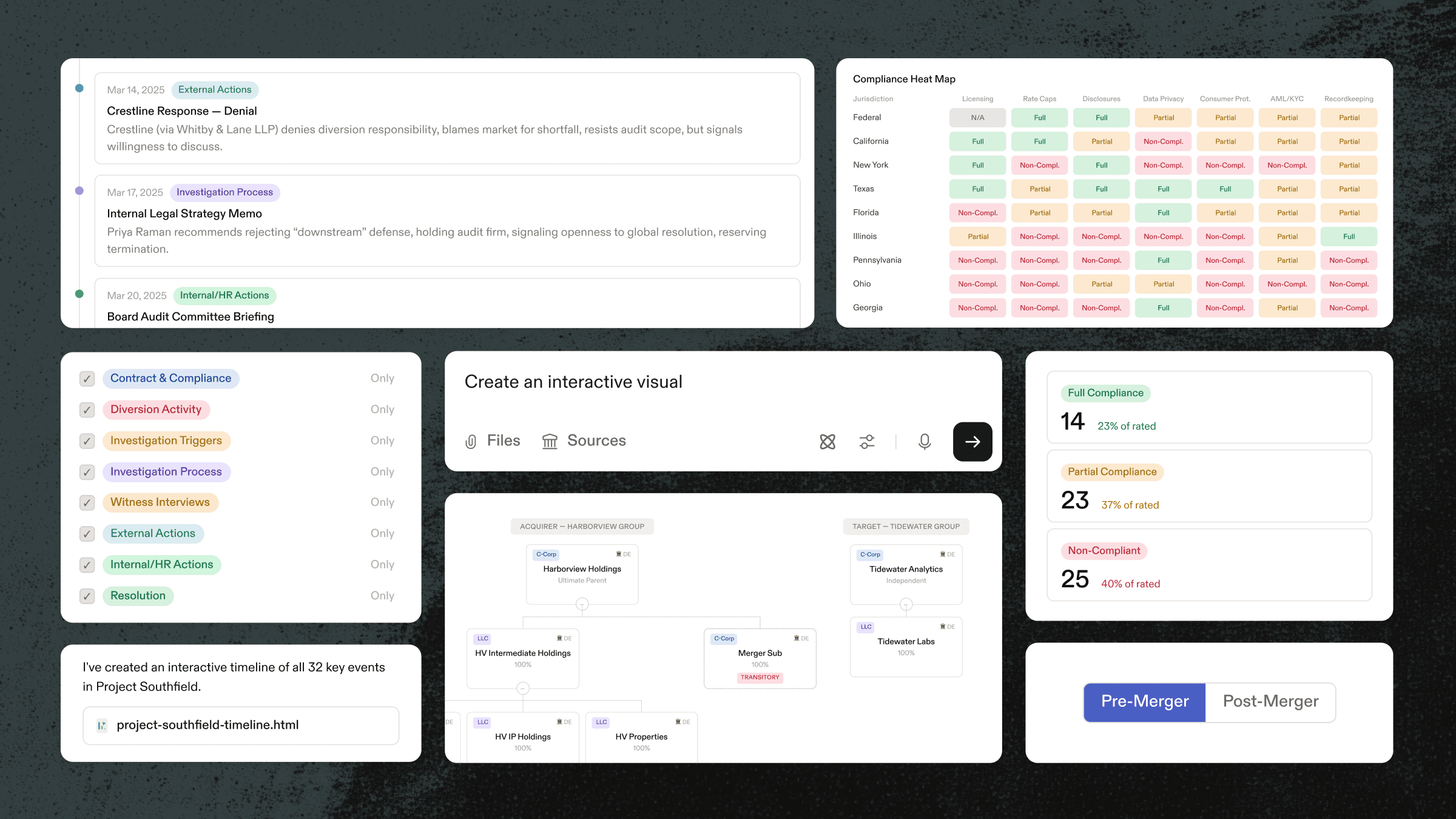
See how legal and compliance teams turn regulatory and policy data into structured outputs directly in Harvey.
Step 2: Find the Gap Between Rule Requirements and What the Business Does Today
Legal's job is to keep internal policies aligned with the regulations the business is subject to — and aligned with each other across subsidiaries and jurisdictions. That's where AI-assisted gap analysis does some of its most useful work.
The specific tasks that get handled here are:
- Comparing existing policies against a new regulation to find missing provisions
- Summarizing overlaps between multiple internal policies to flag redundancy
- Drafting language to close the gaps once they're identified
- Separating employee obligations from management obligations so responsibilities route to the right people
- Comparing draft policies against industry standards or peer benchmarks
Legal often gets called in on policy work even when compliance owns the policy itself, because the interpretive judgment sits with legal. A gap analysis isn't just, “Does the language match the regulation?” It's, “Does the language reflect how the business really runs, and if not, what changes?”
In Practice: Financial services in-house teams work through a constant stream of prudential, anti-money-laundering, market conduct, and other regulatory requirements. Each can affect multiple parts of the operating model at once. In January 2026, HSBC chose Harvey as part of its broader commitment to an AI-enabled legal operating model, citing the need to help its legal organization navigate a complex and dynamic legal and regulatory environment. For a closer look at how in-house teams can apply Harvey across regulatory monitoring, applicability assessment, obligation mapping, policy gap analysis, and compliance workflows, see Harvey in Practice: In-House Regulatory and Compliance.
Finding a gap is only the first part of the analysis. Legal then has to trace what that gap affects across the business and determine whether the proposed response is consistent with both internal practice and external expectations.
Trace the Gap Across the Business
A policy gap rarely stays confined to the policy itself. A single regulatory change can affect:
- Contracts
- Privacy language
- Supplier requirements
- Internal policies
- Operating procedures
- Employee guidance
- Training
- Executive reporting
This is where AI does more than summarize. Working across contracts, policies, and procedures at the same time surfaces downstream effects that would otherwise never get traced.
Once legal understands the internal impact, external benchmarks can provide another useful check. Peer practice doesn’t determine whether the company is compliant, but it can help legal understand how comparable organizations disclose, structure, or operationalize similar requirements.
Where Peer Practice Helps (and Where it Doesn’t)
Legal uses public filings and internal precedent to check the company's compliance posture against peers. Harvey's EDGAR web search and deep research capabilities handle the benchmarking work by:
- Extracting competitor compliance disclosures from EDGAR filings
- Benchmarking ESG policies against peer disclosures
- Comparing competitor codes of conduct against the company's own
- Extracting compliance program structures from peer filings
- Comparing data privacy provisions or whistleblowing policies across the industry
Step 3: Turn Compliance Analysis Into Decisions the Business Can Act On
Obligation tracking is only useful if it produces evidence the board, the executive committee, or the audit committee can review and act on.
That workspace has to hold the source material, produce outputs on demand, and stay current as regulations shift. In practice, that means:
- Storing all policies, contracts, and regulatory documents in one persistent workspace
- Answering policy questions in real time when an executive asks
- Mapping historic policy versions to show how positions have evolved
- Indexing policies with metadata (title, date, owner, status) so the register is queryable
- Consolidating regional policies into a global view
- Flagging outdated policies automatically via issue and expiry dates
One-page executive explainers of new regulations are one output legal gets asked for. Checklists, revised procedures, and training materials are others — all downstream of the same obligation register.
The bigger shift is in the tempo of board reporting. Instead of a periodic construction project (six weeks of collecting inputs, formatting, and reviewing), the report becomes a snapshot that legal produces on demand from the underlying workspace.
Human Judgment Moves Upstream, Not Out of the Workflow
AI handles monitoring, synthesis, comparison, extraction, and drafting. It doesn't decide materiality, acceptable risk, interpretation of ambiguous rules, or when to escalate. That work still sits with the lawyer, but it moves upstream. Instead of spending hours building the obligation register, the lawyer spends that time deciding which obligations are material, calibrating fallbacks, and approving policy changes.
That's the human-in-the-loop principle applied to compliance work. AI carries the extraction and comparison. Legal carries the judgment. The workflow gets faster and more defensible at the same time.
Where Harvey Sits in the Coordination Workflow
Harvey connects the different parts of the coordination workflow in one environment. Vault brings together policies, contracts, regulatory materials, and institutional knowledge so teams can analyze them in context. Harvey supports the extraction, comparison, research, and drafting work across those materials, while workflow agents can turn repeatable processes such as obligation mapping, gap analysis, and compliance reviews into structured workflows tailored to the organization’s standards. Harvey’s legal knowledge sources, web search, and deep research capabilities also support external research and peer benchmarking.
Compliance coordination is one part of a broader set of workflows Harvey supports for in-house legal teams, from regulatory research and contract review to policy analysis and legal operations.
For teams focused specifically on regulatory change, How In-House Compliance Teams Use AI to Stay Ahead of Regulatory Change explores how legal and compliance functions can assess applicability, map obligations, and update policies as requirements evolve. Harvey in Practice: In-House Regulatory and Compliance shows those workflows in Harvey, while our contract lifecycle management guidance goes deeper on obligations that originate in executed agreements, including renewal dates, deliverables, and other post-signature commitments.
FAQs About AI’s Role in Compliance Management
1. What's the difference between compliance management and regulatory compliance?
Compliance management covers ongoing obligation tracking and documentation across regulations, contracts, and policies — the connective tissue between those different sources of obligations. Regulatory compliance focuses more specifically on interpreting and acting on regulatory requirements from a designated regulatory function. See the corporate compliance and regulatory compliance pieces for the related workflows.
2. Can AI extract obligations from a regulation my team hasn't seen before?
Yes. The AI reads the regulation cold and returns a structured table of obligations, deadlines, and applicable parties. The legal team confirms scope and applicability against the business context.
3. Can Harvey process regulations in languages other than English?
Yes. Harvey processes regulatory text in the source language and can return a structured English summary of obligations. This matters most for teams tracking EU, LATAM, or APAC regulations where the authoritative text isn't in English.
4. How is company data handled inside the workspace?
Harvey is a legal AI platform designed for confidential work. Company policies, contracts, and regulatory documents stay inside the customer's workspace and aren't used to train models.
5. Does obligation tracking cover post-signature contract commitments?
Yes at a high level — the same workspace tracks obligations that come from executed contracts, including renewal triggers and information rights. For the deeper post-signature workflow (renewal dates, deliverables, breach triggers), see the contract lifecycle management piece.


